 Bug FAQ
Banded Centipede
Lithobius variegatus · Order: Lithobiomorpha · Family: Lithobiidae

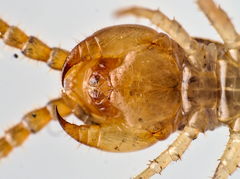
The common banded centipede has purple or brown rings around each leg, which set it apart from the similar Lithobius forficatus. It lives in Europe, including the British Isles, Channel Islands, parts of Spain, Portugal, Italy, Morocco and Tunisia. It feeds on small invertebrates such as woodlice and millipedes.
Source: Wikipedia
How to recognize it
Look for conspicuous purple or brown rings around the legs.
Source: Wikipedia
What it eats
Preys on small invertebrates such as woodlice (e.g., Philoscia muscorum, Oniscus asellus) and millipedes.
Source: Wikipedia
Where it comes from
Native to the British Isles and also recorded in the Channel Islands, north-western Spain, northern Portugal, southern Italy, Morocco and Tunisia.
Source: Wikipedia
Lookalikes
Can be confused with Lithobius forficatus, but the banded centipede has distinct colored leg rings.
Source: Wikipedia
More photos


Questions people ask
How can I tell the banded centipede apart from similar species?
Check the legs to the banded centipede has noticeable purple or brown rings around each leg, which Lithobius forficatus lacks.
Source: Wikipedia
Where is the common banded centipede found?
It occurs across Europe, including the British Isles, Channel Islands, parts of Spain, Portugal, Italy, Morocco and Tunisia.
Source: Wikipedia
What does the banded centipede eat?
It hunts small invertebrates such as woodlice and millipedes.
Source: Wikipedia
Same family (Lithobiidae)



Sources
- Wikipedia: https://en.wikipedia.org/wiki/Lithobius_variegatus
Look it up elsewhere: GBIF · iNaturalist · BugGuide · ITIS · Wikipedia
Text written 2026-10-23 from the sources above and checked sentence by sentence against them. Data fetched 2026-10-22.