 Bug FAQ
Brown Centipede
Lithobius forficatus · Order: Lithobiomorpha · Family: Lithobiidae
Also called: Centipede, Common centipede, Stone Centipede, common garden centipede
Source: Wikipedia
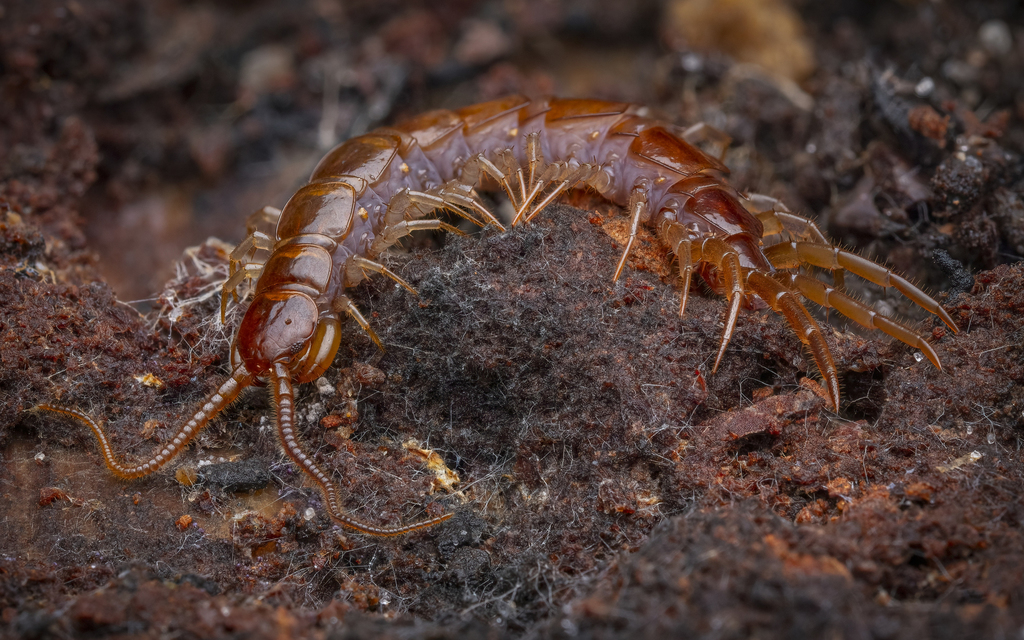
The brown centipede is 18 to 30 mm long and up to 4 mm wide. It hunts insects, spiders, slugs, worms and flies, using venom-filled front legs to subdue prey.
Source: Wikipedia
How to recognize it
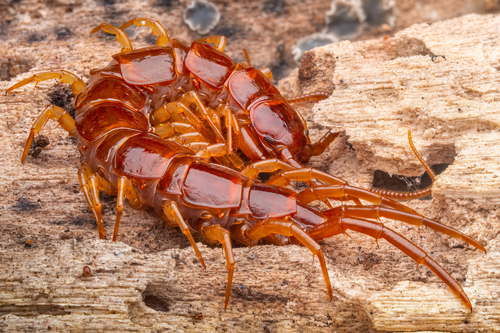
Its legs have no stripes.
Source: Wikipedia
Size
Adults measure between 18 and 30 mm in length and can be up to 4 mm broad.
Source: Wikipedia
Does it bite or sting?
Bites are rare, usually do not break the skin, and cause only brief localized pain.
Source: Wikipedia
Where it lives
It lives in the upper soil layers, often under rocks and rotting logs.
Source: Wikipedia
What it eats
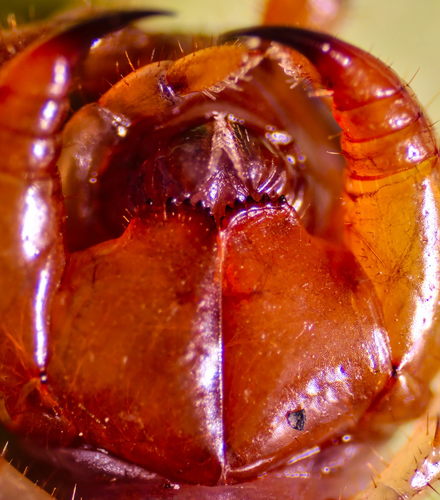
It is a predator that eats insects, spiders, slugs, worms and flies. Its front legs act like fangs and inject venom to overpower prey.
Source: Wikipedia
Life cycle
Young centipedes hatch with seven leg pairs and add a new pair with each molt. Adults have up to 15 pairs of legs.
Source: Wikipedia
Where it comes from
It is native to Europe and North America and is also found in the Hawaiian Islands.
Source: Wikipedia
Lookalikes
It resembles other European lithobiid centipedes, especially the striped Lithobius variegatus.
Source: Wikipedia
Where it is found in the US
Recorded in 46 of 51 states and DC. Most records: Massachusetts, Illinois, Pennsylvania, New York, Texas, Michigan, Minnesota, Colorado.
Darker = more records. Counts are museum and citizen-science records, not population size.
Source: GBIF
Status: introduced in North America; introduced in United States; introduced in Canada. Source: iNaturalist
Months it is reported in the US
Source: GBIF
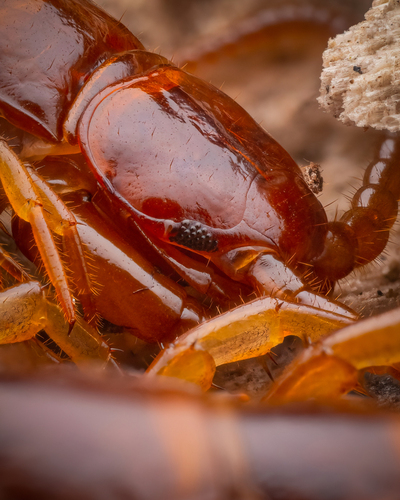
More photos
Questions people ask
Do they bite?
Yes, they can bite but the bite is mild and only causes brief localized pain.
Source: Wikipedia
What do they eat?
They prey on insects, spiders, slugs, worms and flies, using venom-filled front legs to subdue them.
Source: Wikipedia
Same family (Lithobiidae)
Sources
- Wikipedia: https://en.wikipedia.org/wiki/Lithobius_forficatus
Look it up elsewhere: GBIF · iNaturalist · BugGuide · ITIS · Wikipedia
Text written 2026-10-22 from the sources above and checked sentence by sentence against them. Data fetched 2026-10-22.