 Bug FAQ
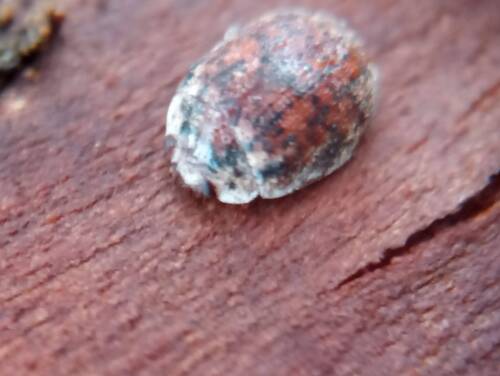
Australian Tortoise Beetle
Trachymela sloanei · Order: Coleoptera · Family: Chrysomelidae
Also called: Eucalyptus tortoise beetle, Small eucalyptus tortoise beetle
Source: Wikipedia
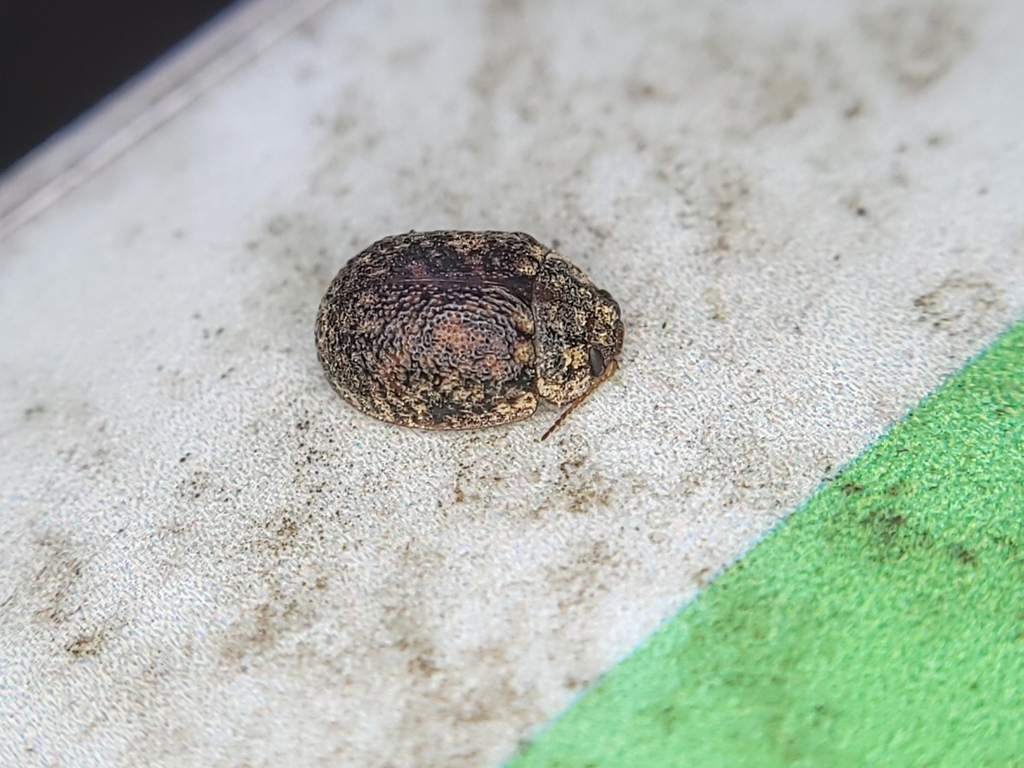
The Australian tortoise beetle lives on eucalyptus trees in its native Australia. It has become an invasive pest in California and several other countries, harming eucalyptus foliage.
Source: Wikipedia
Is it a pest in the house?
It is considered an invasive pest in California and other countries.
Source: Wikipedia
Where it lives
It lives on eucalyptus trees in Australia. It is now found as an invasive pest in California and other regions.
Source: Wikipedia
What it eats
It feeds on eucalyptus leaves.
Source: Wikipedia
Where it comes from
It is native to Australia.
Source: Wikipedia
Where it is found in the US
Recorded in 4 of 51 states and DC. Most records: California, Arizona, Hawaii, Michigan.
Darker = more records. Counts are museum and citizen-science records, not population size.
Source: GBIF
Status: introduced in United States. Source: iNaturalist
Months it is reported in the US
Source: GBIF
More photos
Questions people ask
Is the Australian tortoise beetle a problem for my garden?
Yes, it feeds on eucalyptus leaves and can damage ornamental or shade trees.
Source: Wikipedia
Where does this beetle come from?
It is native to Australia and lives on eucalyptus trees there.
Source: Wikipedia
Has it spread outside Australia?
It is now an invasive pest in California and has been reported in China, Chile, Spain, Portugal and Greece.
Source: Wikipedia
Same family (Chrysomelidae)
 Spotted Cucumber BeetleDiabrotica undecimpunctataDamages trees, gardens or crops
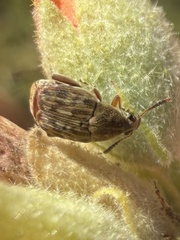 Bean WeevilAcanthoscelides obtectusDamages trees, gardens or crops
 Cowpea WeevilCallosobruchus maculatusDamages trees, gardens or crops
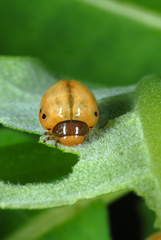 Swamp Milkweed Leaf BeetleLabidomera clivicollisDamages trees, gardens or crops
 Alder Leaf BeetleAgelastica alniDamages trees, gardens or crops
 Dogbane Leaf BeetleChrysochus auratus
Sources
- Wikipedia: https://en.wikipedia.org/wiki/Trachymela_sloanei
Look it up elsewhere: GBIF · iNaturalist · BugGuide · ITIS · Wikipedia
Text written 2026-10-23 from the sources above and checked sentence by sentence against them. Data fetched 2026-10-23.