 Bug FAQ
Auplopus architectus
Auplopus architectus · Order: Hymenoptera · Family: Pompilidae
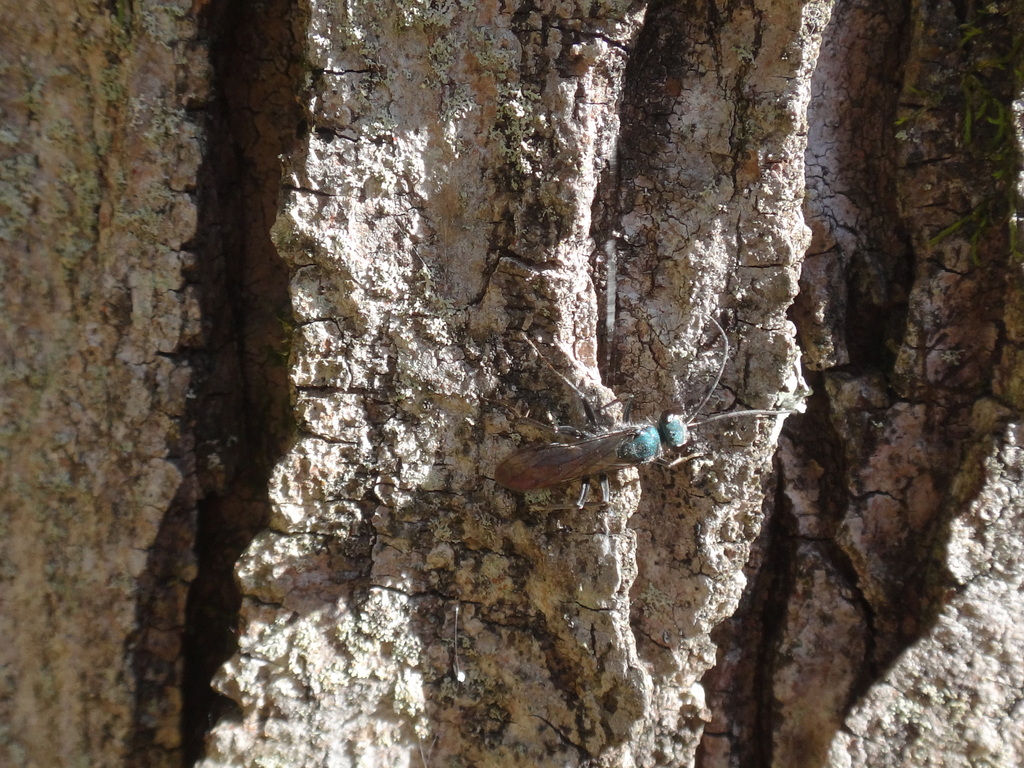
Females grow to about one and a half inches long and have an iridescent exoskeleton, especially in the metallicus form. They have a black head, amber-colored wings, live mainly in wooded areas, and can be found near old buildings in towns. Separate populations occur in California, the northeastern United States, and Arkansas.
Source: Wikipedia
How to recognize it
The exoskeleton shines with an iridescent sheen, especially in the metallicus form.
Source: Wikipedia
Size
Females are about one and a half inches long.
Source: Wikipedia
Where it lives
It is mostly found in wooded areas. In civilized areas it occurs near old buildings.
Source: Wikipedia
Where it comes from
Separate populations exist in California, the northeastern United States, and Arkansas.
Source: Wikipedia
Where it is found in the US
Recorded in 19 of 51 states and DC. Most records: California, Ohio, Illinois, New Jersey, Maryland, Utah, Kansas, Minnesota.
Darker = more records. Counts are museum and citizen-science records, not population size.
Source: GBIF
Months it is reported in the US
Source: GBIF
Questions people ask
What does Auplopus architectus look like?
It has an iridescent exoskeleton (especially the metallicus form), a black head, and amber-colored wings.
Source: Wikipedia
Where is Auplopus architectus found?
It lives mainly in wooded areas and near old buildings in towns, with separate groups in California, the northeastern United States, and Arkansas.
Source: Wikipedia
Same family (Pompilidae)
Sources
- Wikipedia: https://en.wikipedia.org/wiki/Auplopus_architectus
Look it up elsewhere: GBIF · iNaturalist · BugGuide · Wikipedia
Text written 2026-10-27 from the sources above and checked sentence by sentence against them. Data fetched 2026-10-27.