 Bug FAQ
Asiatic Wall Jumping Spider
Attulus fasciger · Order: Araneae · Family: Salticidae
Also called: Asian Wall Jumping Spider, Asian Wall Jumper, Asiatic Wall Jumper

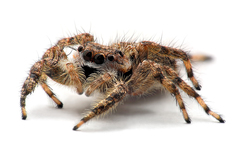
The Asiatic wall jumping spider is a small, brownish-black spider about 3 to 4 mm long with eight eyes. Males look like females but have a slimmer abdomen and larger black palps. It lives on man-made structures and uses artificial lights to catch prey at night.
Source: Wikipedia
How to recognize it
Brownish-black colour, eight eyes, 3 to 4 mm in length. Males have a slimmer abdomen and larger black palps compared with females.
Source: Wikipedia
Size
Adults measure about 3 to 4 mm (0.12 to 0.16 in) long.
Source: Wikipedia
Is it a pest in the house?
Its success in homes comes from living on man-made structures that provide refuge and camouflage.
Source: Wikipedia
Where it lives
It thrives on buildings and other man-made structures that give it shelter and camouflage. Artificial lighting on these structures attracts insects, giving the spider extra foraging opportunities at night.
Source: Wikipedia
What it eats
It hunts insects drawn to lights on buildings.
Source: Wikipedia
Where it comes from
Originally native to north and west Asia. It has been introduced to North America.
Source: Wikipedia
Where it is found in the US
Recorded in 43 of 51 states and DC. Most records: Minnesota, Colorado, Ohio, New York, Pennsylvania, Illinois, Wisconsin, Michigan.
Darker = more records. Counts are museum and citizen-science records, not population size.
Source: GBIF
Status: introduced in North America; introduced in Canada; introduced in United States. Source: iNaturalist
Months it is reported in the US
Source: GBIF
More photos

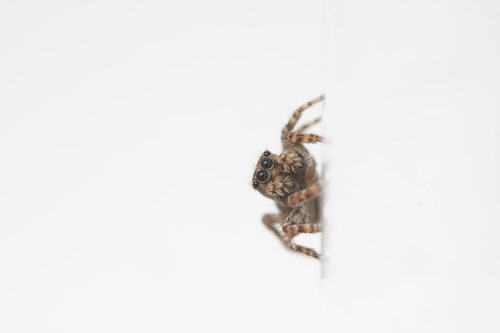
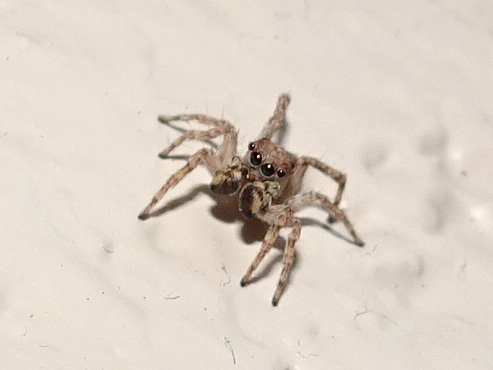
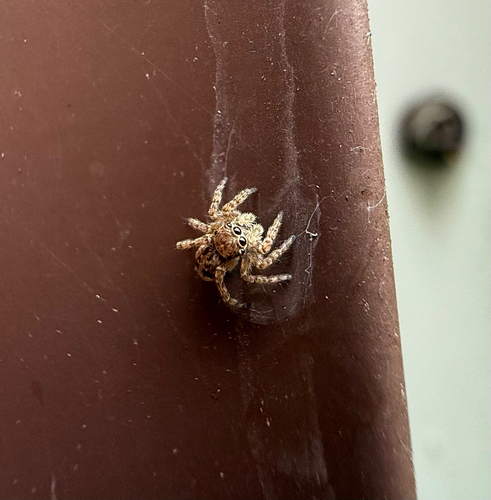
Same family (Salticidae)
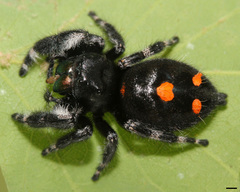



Sources
- Wikipedia: https://en.wikipedia.org/wiki/Attulus_fasciger
Look it up elsewhere: GBIF · iNaturalist · BugGuide · ITIS · Wikipedia
Text written 2026-10-22 from the sources above and checked sentence by sentence against them. Data fetched 2026-10-22.