 Bug FAQ
April Green Cicada
Kikihia ochrina · Order: Hemiptera · Family: Cicadidae

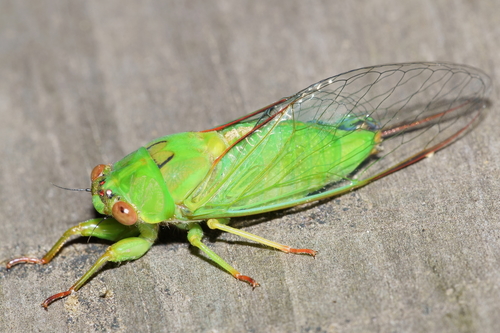
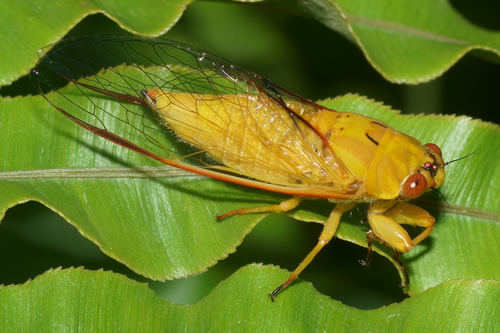
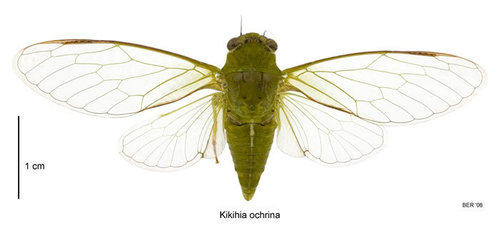
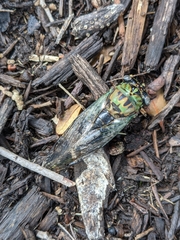
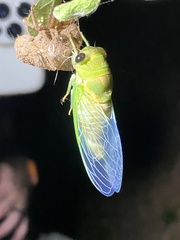
The April Green Cicada is bright green with two sickle-shaped lines and two dots on the middle of the thorax. Adults appear mainly in April on the North Island, while eggs are laid from January to May and nymphs spend about two years underground before emerging.
Source: Wikipedia
How to recognize it
It has bright green legs without the pink patches seen in its close relative Kikihia dugdalei.
Source: Wikipedia
Where it lives
It lives in evergreen trees and shrubs such as Coprosma, Hebe, Myoporum, and introduced poplars. It often emerges from soil beneath mahoe trees.
Source: Wikipedia
What it eats
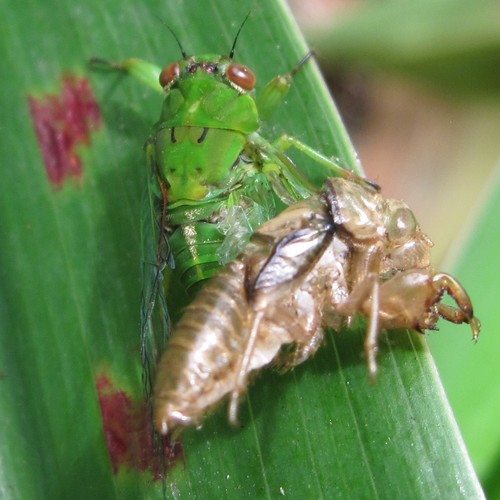
Eggs are laid from January to May, peaking in March. After hatching, the nymphs immediately bury themselves underground for about two years.
Source: Wikipedia
Life cycle
The species has a three-year life cycle; eggs mature over 7 to 11 months before hatching.
Source: Wikipedia
When you see it
Adults are most commonly seen in April on the North Island.
Source: Wikipedia
Where it comes from
It is found in New Zealand’s North Island, the Three Kings Islands, and has been introduced to Canterbury.
Source: Wikipedia
Lookalikes
It can be told apart from Kikihia dugdalei by its green legs lacking pink patches. Male K. ochrina also lack the small black spots on the underside that most male K. dugdalei have.
Source: Wikipedia
More photos
Questions people ask
When are April Green Cicadas most visible?
Adults are most commonly seen in April, though they start appearing in February.
Source: Wikipedia
Same family (Cicadidae)
Sources
- Wikipedia: https://en.wikipedia.org/wiki/Kikihia_ochrina
Look it up elsewhere: GBIF · iNaturalist · BugGuide · Wikipedia
Text written 2026-10-23 from the sources above and checked sentence by sentence against them. Data fetched 2026-10-23.