 Bug FAQ
Apache Jumping Spider
Phidippus apacheanus · Order: Araneae · Family: Salticidae
Also called: Red Velvet Jumping Spider

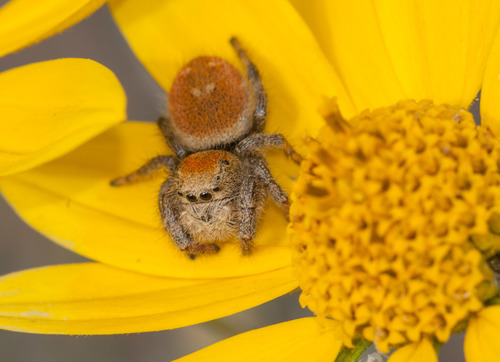
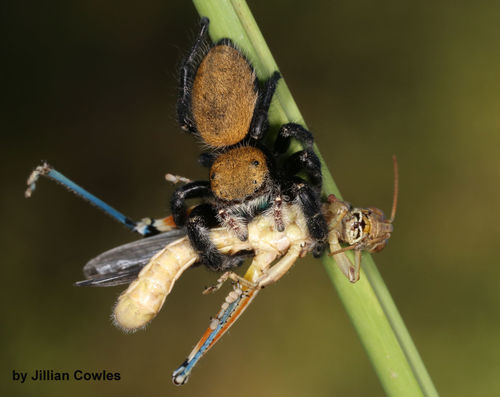
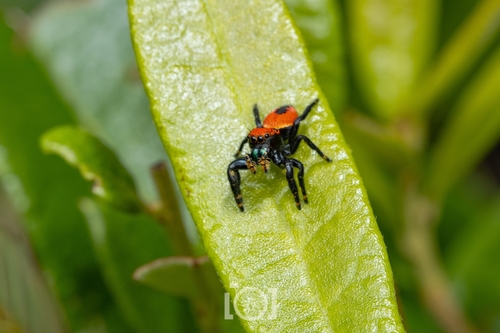
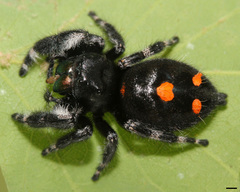
Males are about 3 mm long while females can reach up to 22 mm. They are black with orange, red or yellow markings, and females often have a black line on the abdomen; their chelicerae are green and iridescent. They live in many open habitats such as grasslands, fields and deserts across the United States, Mexico and Cuba.
Source: Wikipedia
How to recognize it
The spider is black with orange, red or yellow coloration on top, and females usually show a black line on the abdomen; its chelicerae are green and iridescent.
Source: Wikipedia
Size
Males measure about 3.3 mm and large females can be as long as 22 mm.
Source: Wikipedia
Where it lives
It is found in a wide range of open habitats, including grasslands, fields and deserts.
Source: Wikipedia
What it eats
It is thought to mimic the western velvet ant and the Mutillidae family in coloration and shape.
Source: Wikipedia
Life cycle
During courtship the male raises his carapace, tilts his abdomen and lifts his front legs. If the female is receptive she performs an acceptance dance, after which the male gently contacts her.
Source: Wikipedia
Where it comes from
Its range includes the United States, Mexico and Cuba.
Source: Wikipedia
Lookalikes
It resembles the western velvet ant Dasymutilla flammifera and other Mutillidae species.
Source: Wikipedia
Where it is found in the US
Recorded in 29 of 51 states and DC. Most records: Colorado, Texas, Utah, Arizona, New Mexico, Kansas, Nebraska, Oklahoma.
Darker = more records. Counts are museum and citizen-science records, not population size.
Source: GBIF
Status: native in North America; native in United States. Source: iNaturalist
Months it is reported in the US
Source: GBIF
More photos
Questions people ask
What does the Apache Jumping Spider look like?
It is black with orange, red or yellow markings on top, females often have a black line on the abdomen, and its chelicerae are green and iridescent.
Source: Wikipedia
Same family (Salticidae)



Sources
- Wikipedia: https://en.wikipedia.org/wiki/Phidippus_apacheanus
Look it up elsewhere: GBIF · iNaturalist · BugGuide · ITIS · Wikipedia
Text written 2026-10-23 from the sources above and checked sentence by sentence against them. Data fetched 2026-10-23.