 Bug FAQ
Anza-Borrego Hairy Scorpion
Hadrurus anzaborrego · Order: Scorpiones · Family: Hadruridae
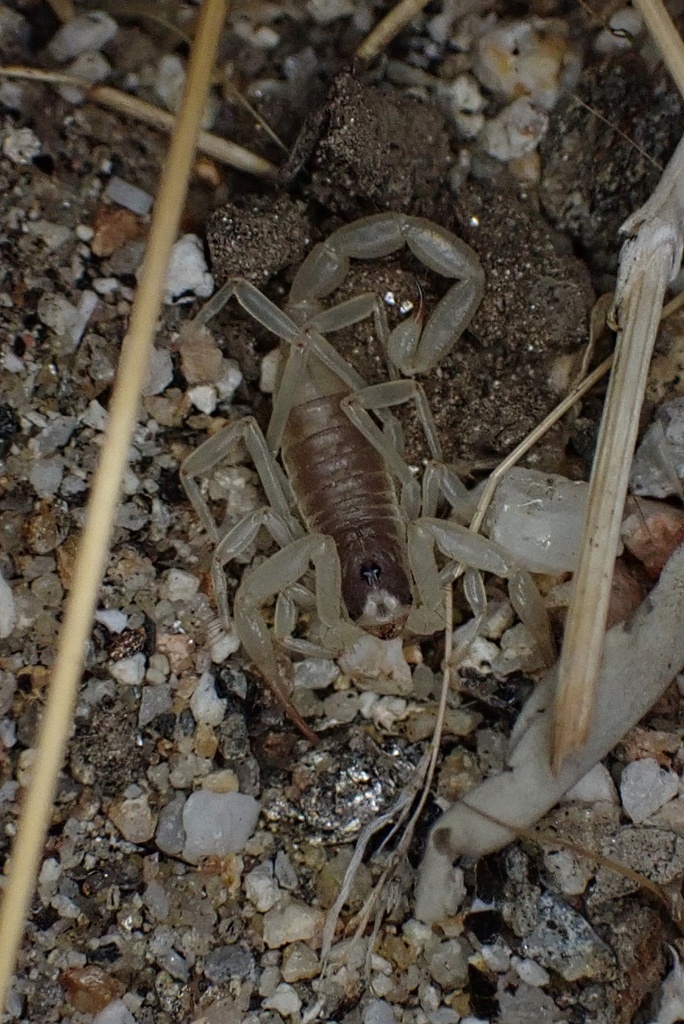
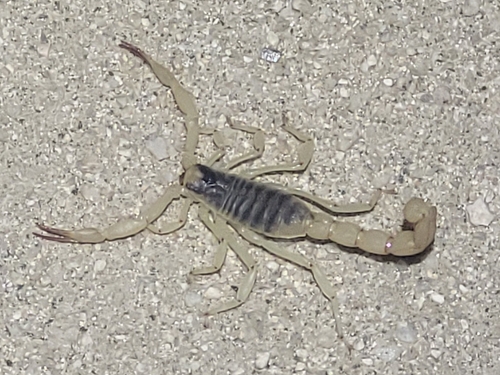
The Anza-Borrego hairy scorpion grows up to about 11 cm (4.3 in) long. It can be pale yellow or dark-colored with a distinctive dark V-shaped mark near the eyes. It lives on coarse sand and rocky areas of the western Colorado Desert in southern California and northern Baja California.
Source: Wikipedia
Size
Adults can reach up to 11 cm (4.3 in) in length.
Source: Wikipedia
Where it lives
Prefers coarse sand and rockier sites compared with its close relative H. arizonensis.
Source: Wikipedia
Where it is found in the US
Recorded in 1 of 51 states and DC. Most records: California.
Darker = more records. Counts are museum and citizen-science records, not population size.
Source: GBIF
Status: native in North America; native in United States. Source: iNaturalist
Months it is reported in the US
Source: GBIF
More photos
Questions people ask
How can I tell the Anza-Borrego hairy scorpion apart from similar scorpions?
Look for the dark V-shaped mark near the eyes; light forms are pale yellow, while dark forms have a black posterior carapace and mesosoma.
Source: Wikipedia
Same family (Hadruridae)
Sources
- Wikipedia: https://en.wikipedia.org/wiki/Hadrurus_anzaborrego
Look it up elsewhere: GBIF · iNaturalist · BugGuide · Wikipedia
Text written 2026-10-28 from the sources above and checked sentence by sentence against them. Data fetched 2026-10-28.