 Bug FAQ
Anopheles gambiae
Anopheles gambiae · Order: Diptera · Family: Culicidae


Anopheles gambiae is one of the most efficient carriers of malaria. It also transmits the parasite that causes lymphatic filariasis, leading to elephantiasis.
Source: Wikipedia
How to recognize it
Members of this species complex look very similar and are hard to tell apart, though larvae and adult females can sometimes be distinguished.
Source: Wikipedia
Is it a pest in the house?
Keep windows and doors closed or screened to keep these mosquitoes out of your home. Repair any broken screens on windows, doors, porches, or patios.
Source: CDC
Does it bite or sting?
It is a highly efficient malaria vector, and most malaria cases come from the bite of an infected mosquito. It also spreads Wuchereria bancrofti, the parasite that causes lymphatic filariasis (elephantiasis).
Where it lives
Anopheles gambiae mainly feeds on humans rather than animals.
Source: Wikipedia
Questions people ask
Does Anopheles gambiae bite humans?
Yes, it bites humans and can transmit malaria and lymphatic filariasis.
What diseases does it spread?
It spreads malaria and the parasite that causes lymphatic filariasis (elephantiasis).
Source: Wikipedia
How can I keep it out of my house?
Keep windows and doors closed or screened, and repair any broken screens.
Source: CDC
How can I tell Anopheles gambiae apart from similar mosquitoes?
They are very hard to distinguish visually; only larvae and adult females sometimes show differences.
Source: Wikipedia
Same family (Culicidae)
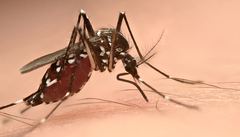 Asian Tiger MosquitoAedes albopictusCan spread germs or disease
 House Mosquito ComplexCulex pipiensCan spread germs or disease
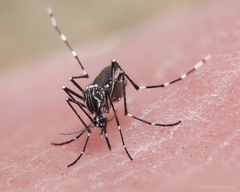 Yellow Fever MosquitoAedes aegyptiCan spread germs or disease
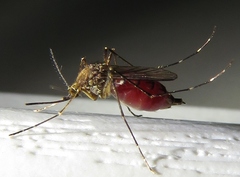 Inland Floodwater MosquitoAedes vexansCan spread germs or disease
 Asian Bush MosquitoAedes japonicusCan bite
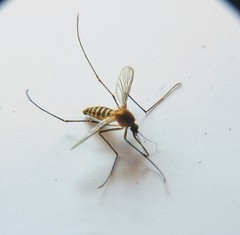 Southern House MosquitoCulex quinquefasciatusCan spread germs or disease
Sources
- Wikipedia: https://en.wikipedia.org/wiki/Anopheles_gambiae
- CDC: https://www.cdc.gov/malaria/about/index.html
Look it up elsewhere: GBIF · iNaturalist · BugGuide · ITIS · Wikipedia
Text written 2026-10-22 from the sources above and checked sentence by sentence against them. Data fetched 2026-10-22.