 Bug FAQ
Anisostena gracilis
Anisostena gracilis · Order: Coleoptera · Family: Chrysomelidae
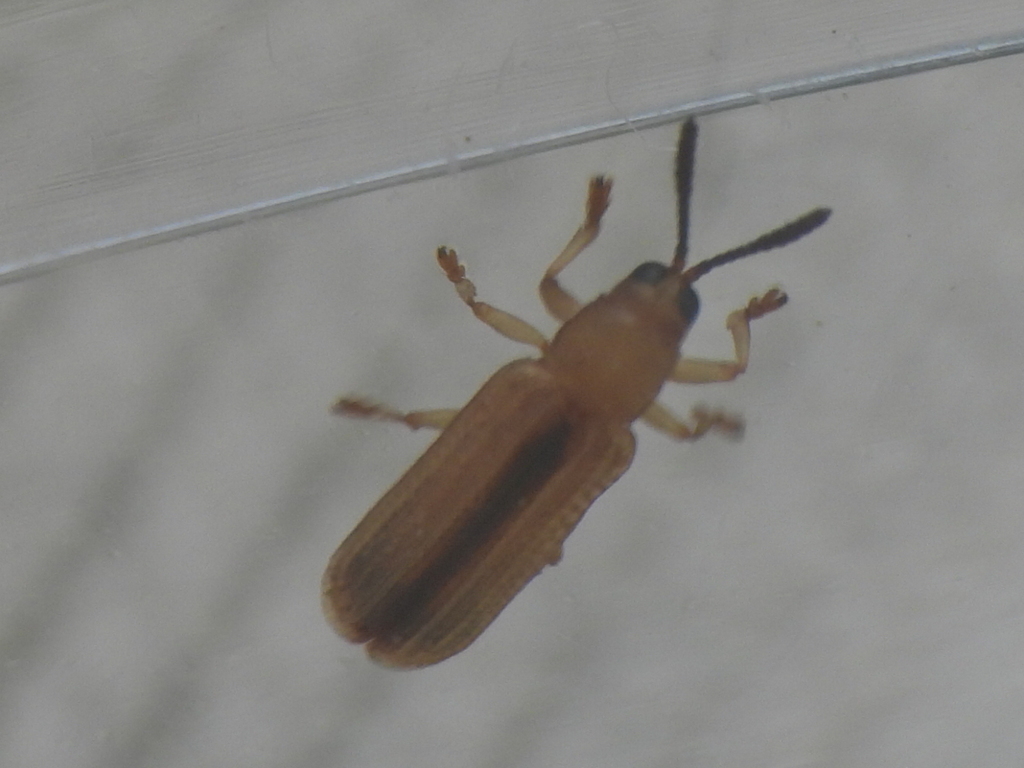
Adults are tiny, measuring about 3 to 3.7 mm long. They display orange-red or yellowish bodies marked with a black line along the back. The beetle occurs in Central and North America, recorded from Arizona, Texas and several Mexican states. It has been observed feeding on the grass Panicum maximum.
Source: Wikipedia
Size
Adults reach a length of roughly 3 to 3.7 mm.
Source: Wikipedia
What it eats
This species feeds on the grass Panicum maximum.
Source: Wikipedia
Where it is found in the US
Recorded in 2 of 51 states and DC. Most records: Texas, Arizona.
Darker = more records. Counts are museum and citizen-science records, not population size.
Source: GBIF
Questions people ask
What does Anisostena gracilis look like?
It is orange-red or yellowish with a black line along the back and is only about 3 to 3.7 mm long.
Source: Wikipedia
Where is Anisostena gracilis found?
It occurs in Central and North America, recorded from Arizona, Texas and several states in Mexico.
Source: Wikipedia
What does Anisostena gracilis eat?
It has been found feeding on the grass Panicum maximum.
Source: Wikipedia
Same family (Chrysomelidae)
 Spotted Cucumber BeetleDiabrotica undecimpunctataDamages trees, gardens or crops
 Bean WeevilAcanthoscelides obtectusDamages trees, gardens or crops
 Cowpea WeevilCallosobruchus maculatusDamages trees, gardens or crops
 Swamp Milkweed Leaf BeetleLabidomera clivicollisDamages trees, gardens or crops
 Alder Leaf BeetleAgelastica alniDamages trees, gardens or crops
 Dogbane Leaf BeetleChrysochus auratus
Sources
- Wikipedia: https://en.wikipedia.org/wiki/Anisostena_gracilis
Look it up elsewhere: GBIF · iNaturalist · BugGuide · ITIS · Wikipedia
Text written 2026-10-29 from the sources above and checked sentence by sentence against them. Data fetched 2026-10-29.