 Bug FAQ
Anisoplaca achyrota
Anisoplaca achyrota · Order: Lepidoptera · Family: Gelechiidae
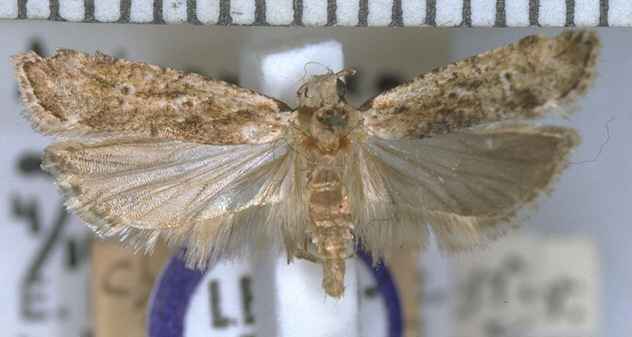
Anisoplaca achyrota is a small moth with a wingspan of about 17 to 18 mm. It lives in native forests of New Zealand, on both the North and South Islands, including Hawke’s Bay, the West Coast and South Canterbury. The larvae feed on the green seeds of the native tree Hoheria angustifolia, making the species an indicator of mature forest.
Source: Wikipedia
How to recognize it
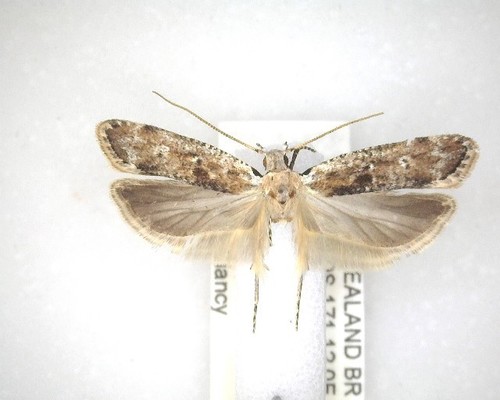
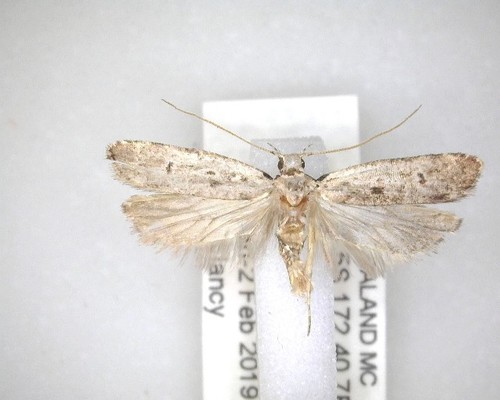
The forewings are a light brown-ochre colour mixed irregularly with whitish and blackish scales. The hindwings are grey and become paler toward the base.
Source: Wikipedia
Size
Wingspan ranges from 17 to 18 mm.
Source: Wikipedia
Where it lives
It inhabits native forest environments.
Source: Wikipedia
Life cycle
Adults are on the wing from December through February. They are attracted to light and are often collected with light traps.
Source: Wikipedia
When you see it
The flight period for adults is December to February.
Source: Wikipedia
Where it comes from
The species is endemic to New Zealand. It occurs on both the North and South Islands, including Hawke’s Bay, the West Coast and South Canterbury.
Source: Wikipedia
Lookalikes
It looks very similar to Anisoplaca cosmia. A key difference is the labial palpus: in A. cosmia the upper part of the second segment is fuscous-black, while in A. achyrota only the lower two-thirds are that colour.
Source: Wikipedia
More photos
Questions people ask
When can I see adult Anisoplaca achyrota?
Adults fly from December through February.
Source: Wikipedia
What do the larvae of this moth eat?
The larvae feed on the green seeds of the native tree Hoheria angustifolia.
Source: Wikipedia
How can I tell this moth apart from Anisoplaca cosmia?
Check the labial palpus: A. achyrota has the lower two-thirds fuscous-black, whereas A. cosmia is fuscous-black on the upper part of the second segment.
Source: Wikipedia
Is this moth attracted to lights?
Yes, it is attracted to light and is often caught in light traps.
Source: Wikipedia
Same family (Gelechiidae)
 Angoumois Grain MothSitotroga cerealellaDamages trees, gardens or crops
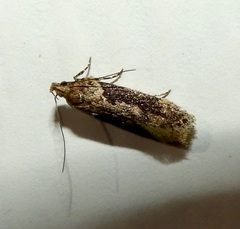 Black-smudged Chionodes MothChionodes mediofuscella
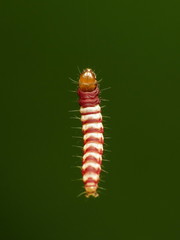 White Stripe-backed MothArogalea cristifasciella
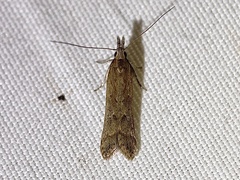 Palmerworm Moth and AlliesDichomeris ligulella
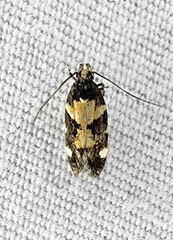 Red-necked Peanutworm MothStegasta bosqueellaDamages trees, gardens or crops
 Tomato StemborerSymmetrischema tangoliasDamages trees, gardens or crops
Sources
- Wikipedia: https://en.wikipedia.org/wiki/Anisoplaca_achyrota
Look it up elsewhere: GBIF · iNaturalist · BugGuide · Wikipedia
Text written 2026-10-23 from the sources above and checked sentence by sentence against them. Data fetched 2026-10-23.