 Bug FAQ
Amazonian Tricolor Centipede
Scolopendra viridicornis · Order: Scolopendromorpha · Family: Scolopendridae

The Brazilian giant centipede lives in the Amazon rainforest, with its type locality in Brazil. It captures prey with its body and legs and then delivers a venomous bite; it can also bite a predator that touches its limbs.
Source: Wikipedia
Does it bite or sting?
It seizes prey with its body and many legs, then injects venom with a bite to subdue and kill it. When a predator touches its raised limbs, it can grip the aggressor and deliver a venomous bite.
Source: Wikipedia
Where it lives
It lives in the Amazon rainforest.
Source: Wikipedia
What it eats
It is carnivorous, feeding on other arthropods.
Source: Wikipedia
Where it comes from
Its type locality is Brazil within the Amazon rainforest.
Source: Wikipedia
More photos


Questions people ask
Where does the Amazonian tricolor centipede live?
It lives in the Amazon rainforest, with its type locality in Brazil.
Source: Wikipedia
What does this centipede eat?
It is carnivorous, eating arthropods and, because of its size, also small vertebrates like rodents, frogs, snakes and lizards.
Source: Wikipedia
Can it bite?
It can bite to subdue prey and to defend itself, delivering venom in the bite.
Source: Wikipedia
Same family (Scolopendridae)
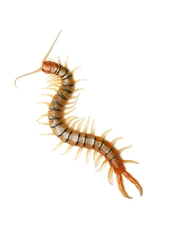 Common Desert CentipedeScolopendra polymorphaCan bite
 Giant Desert CentipedeScolopendra herosCan bite
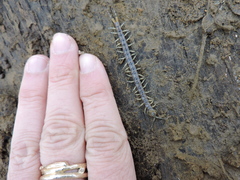 Eastern Bark CentipedeHemiscolopendra marginata
 Mediterranean Banded CentipedeScolopendra cingulataCan bite
 Chinese Red-headed CentipedeScolopendra mutilansCan bite
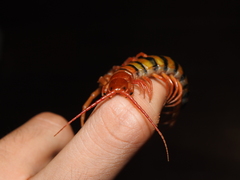 Red-headed CentipedeScolopendra morsitansCan bite
Sources
- Wikipedia: https://en.wikipedia.org/wiki/Scolopendra_viridicornis
Look it up elsewhere: GBIF · iNaturalist · BugGuide · ITIS · Wikipedia
Text written 2026-10-23 from the sources above and checked sentence by sentence against them. Data fetched 2026-10-23.