 Bug FAQ
Alkali Nomia
Nomia melanderi · Order: Hymenoptera · Family: Halictidae
Also called: Alkali Bee
Source: Wikipedia
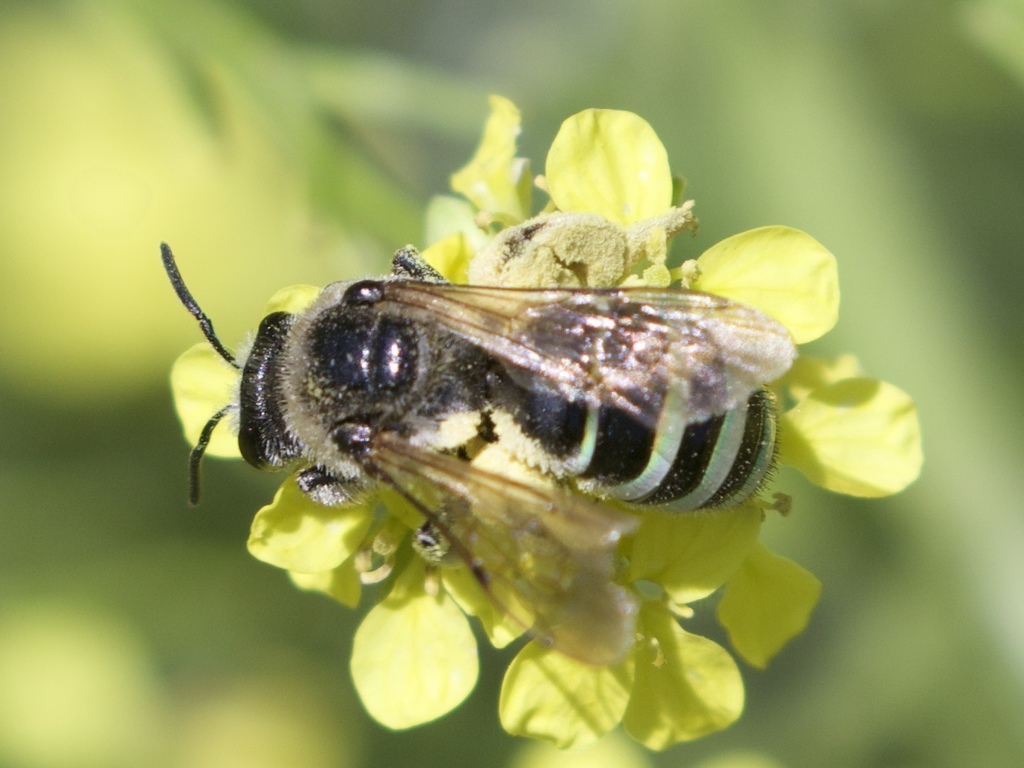
Alkali bees are about two-thirds the size of honeybees and have black with metallic bands on their abdomen; males have white faces while females have a rarely used stinger. Females collect pollen and nectar to make a pollen ball, lay an egg on it, and the larva eats the ball before entering diapause; development from egg to adult takes about 11-12 days.
Source: Wikipedia
How to recognize it
The abdomen shows black and metallic banding. Females possess a stinger that they seldom use. Males can be recognized by their white faces.
Source: Wikipedia
Size
An alkali bee is roughly two-thirds the length of a honeybee.
Source: Wikipedia
Does it bite or sting?
Females have a stinger but use it only rarely.
Source: Wikipedia
Where it lives
They prefer arid desert basins with moist, silty, well-drained soils that have a salty surface and little vegetation.
Source: Wikipedia
What it eats
Females gather pollen and nectar, mix them into a ball, and place it in a nest cell for the larva.
Source: Wikipedia
Life cycle
After the egg is laid on the pollen ball, it hatches in three to four days and the larva eats the ball. When the pollen is consumed, the larva becomes a prepupa, defecates, and then enters diapause. The whole development from egg to adult takes about 11 to 12 days in the wild.
Source: Wikipedia
When you see it
Activity is usually observed in the late afternoon.
Source: Wikipedia
Where it comes from
The alkali bee is native to desert and semi-arid basins of the western United States.
Source: Wikipedia
Where it is found in the US
Recorded in 12 of 51 states and DC. Most records: Utah, California, Washington, Arizona, Colorado, Idaho, Oregon, Wyoming.
Darker = more records. Counts are museum and citizen-science records, not population size.
Source: GBIF
Status: introduced in Canada; native in North America; native in United States. Source: iNaturalist
Months it is reported in the US
Source: GBIF
More photos
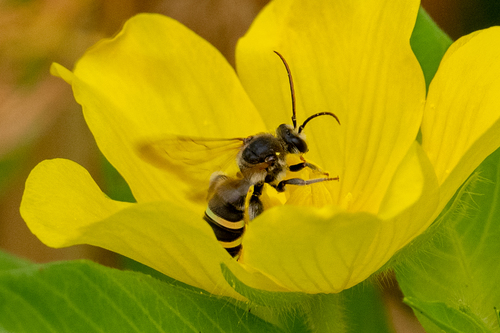
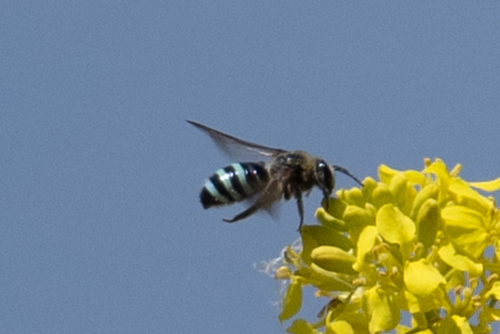
Questions people ask
Do alkali bees sting people?
Yes, females have a stinger but they sting only rarely, and any sting is mild.
Source: Wikipedia
What does an alkali bee look like?
It has black and metallic bands on the abdomen, males have white faces, and females have a rarely used stinger.
Source: Wikipedia
Same family (Halictidae)

Sources
- Wikipedia: https://en.wikipedia.org/wiki/Alkali_bee
Look it up elsewhere: GBIF · iNaturalist · BugGuide · ITIS · Wikipedia
Text written 2026-10-23 from the sources above and checked sentence by sentence against them. Data fetched 2026-10-23.