 Bug FAQ
Adanson's House Jumper
Hasarius adansoni · Order: Araneae · Family: Salticidae
Also called: Adanson's House Jumping Spider, Jumping spider, jumping spiders
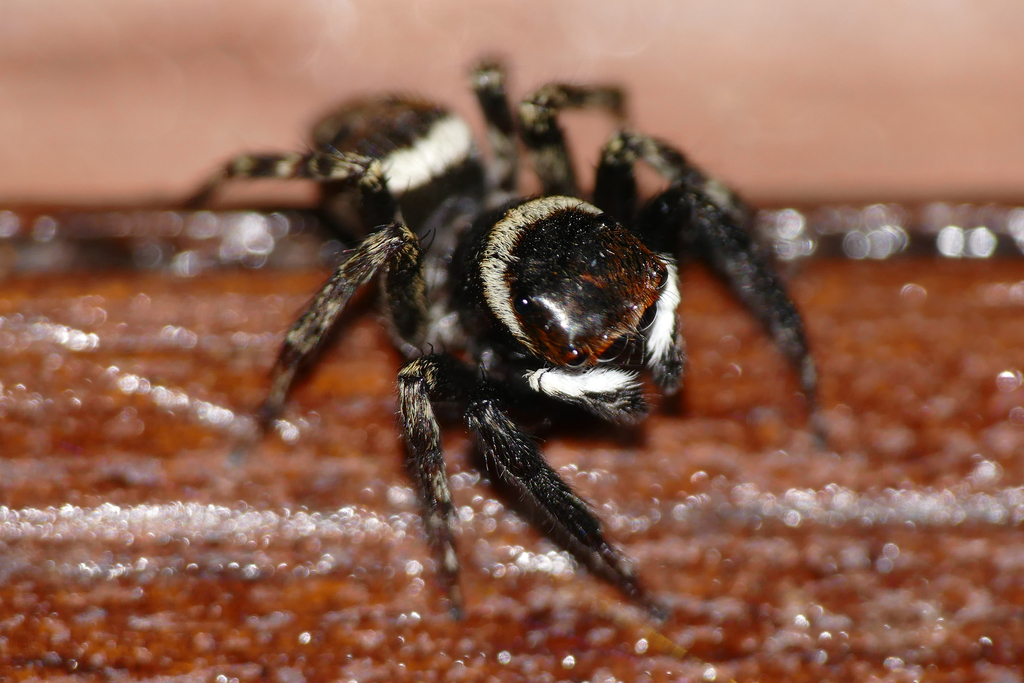
Females can reach about 8 mm and males about 6 mm in length. Males are mostly black with a red facial mask, partly white pedipalps, and both sexes have white crescent markings on the abdomen. They build a silken retreat at night that is roughly twice the spider’s body length and have been introduced worldwide in greenhouses and zoos.
Source: Wikipedia
How to recognize it
Both sexes show white crescent marks on the back and front of the abdomen.
Source: Wikipedia
Size
Females grow up to 8 mm, males up to 6 mm.
Source: Wikipedia
Where it lives
At night they spin a silken retreat about twice their body length.
Source: Wikipedia
Where it is found in the US
Recorded in 15 of 51 states and DC. Most records: Hawaii, Texas, California, Missouri, Arizona, Indiana, Nevada, New Hampshire.
Darker = more records. Counts are museum and citizen-science records, not population size.
Source: GBIF
Status: introduced in North America; introduced in Canada; introduced in United States. Source: iNaturalist
Months it is reported in the US
Source: GBIF
More photos
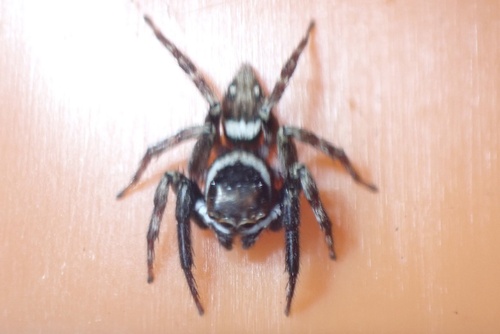
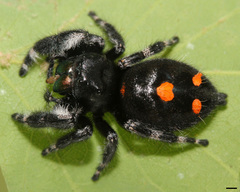
Same family (Salticidae)



Sources
- Wikipedia: https://en.wikipedia.org/wiki/Hasarius_adansoni
Look it up elsewhere: GBIF · iNaturalist · BugGuide · ITIS · Wikipedia
Text written 2026-10-22 from the sources above and checked sentence by sentence against them. Data fetched 2026-10-22.