 Bug FAQ
Abbott's Sphinx
Sphecodina abbottii · Order: Lepidoptera · Family: Sphingidae
Also called: Abbot's Sphinx, Abbott's Sphinx Moth, Abbot's Sphinx Moth
Source: Wikipedia

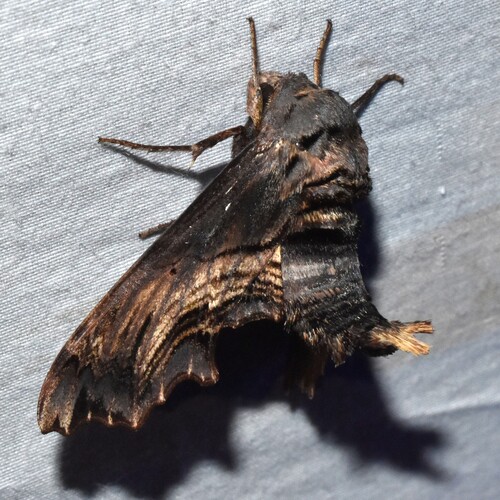
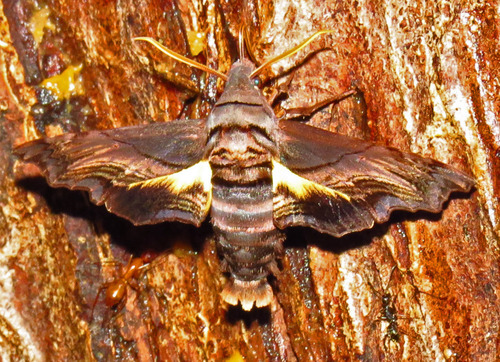
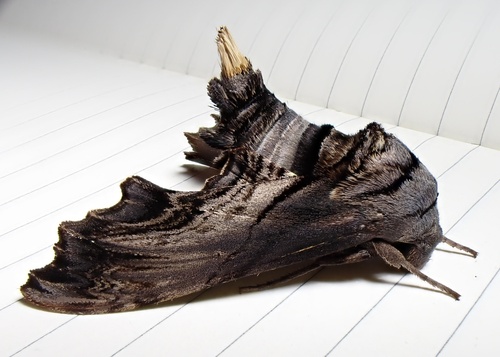
Adult moths are about 75 mm long and have violet-grey forewings with swirling black lines. Their underwings show a bright yellow band and the moth buzzes in flight, looking like a bee. Caterpillars feed on grape vines, Virginia creeper and Ampelopsis species.
Source: Wikipedia
Size
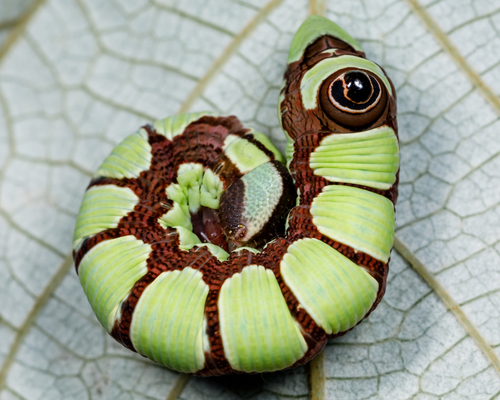
Final-instar caterpillars reach about 75 mm in length.
Source: Wikipedia
Does it bite or sting?
If the larva is pinched or poked, it squeaks and bites the attacker.
Source: Wikipedia
What it eats
Larvae feed on grapes (Vitis), Virginia creeper (Parthenocissus quinquefolia) and Ampelopsis.
Source: Wikipedia
When you see it
In northern areas adults are active in May and June; southern populations produce multiple generations.
Source: Wikipedia
Where it comes from
Its range is central and eastern North America, excluding most of Florida.
Source: Wikipedia
Lookalikes
The bright yellow band on the underwings and the buzzing flight can make it look like a bee.
Source: Wikipedia
Where it is found in the US
Recorded in 37 of 51 states and DC. Most records: Massachusetts, Connecticut, Ohio, New York, Michigan, Pennsylvania, North Carolina, Vermont.
Darker = more records. Counts are museum and citizen-science records, not population size.
Source: GBIF
Status: native in North America; native in Canada; native in United States. Source: iNaturalist
Months it is reported in the US
Source: GBIF
More photos
Questions people ask
Do the caterpillars bite?
Yes, when pinched or poked the larva will squeak and bite.
Source: Wikipedia
What plants do the larvae eat?
They feed on grape vines, Virginia creeper and Ampelopsis species.
Source: Wikipedia
When are adult moths active?
In the north they fly in May and June; in the south they have several generations throughout the warm months.
Source: Wikipedia
How can I tell this moth apart from others?
Look for violet-grey forewings with swirling black lines and a bright yellow band on the underwings; the moth also buzzes like a bee in flight.
Source: Wikipedia
Same family (Sphingidae)
 White-lined SphinxHyles lineataDamages trees, gardens or crops
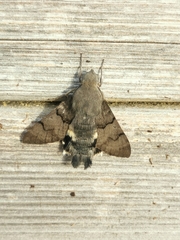 Eurasian Hummingbird HawkmothMacroglossum stellatarum
 Snowberry ClearwingHemaris diffinis
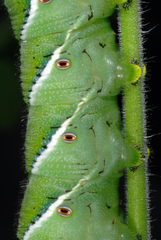 Carolina SphinxManduca sextaDamages trees, gardens or crops
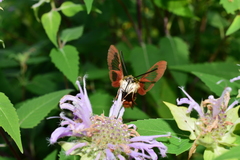 Hummingbird ClearwingHemaris thysbeDamages trees, gardens or crops
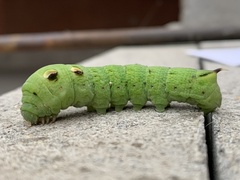 Elephant HawkmothDeilephila elpenor
Sources
- Wikipedia: https://en.wikipedia.org/wiki/Sphecodina_abbottii
Look it up elsewhere: GBIF · iNaturalist · BugGuide · ITIS · Wikipedia
Text written 2026-10-23 from the sources above and checked sentence by sentence against them. Data fetched 2026-10-23.