 Bug FAQ
Ypsolopha falciferella
Ypsolopha falciferella · Order: Lepidoptera · Family: Ypsolophidae
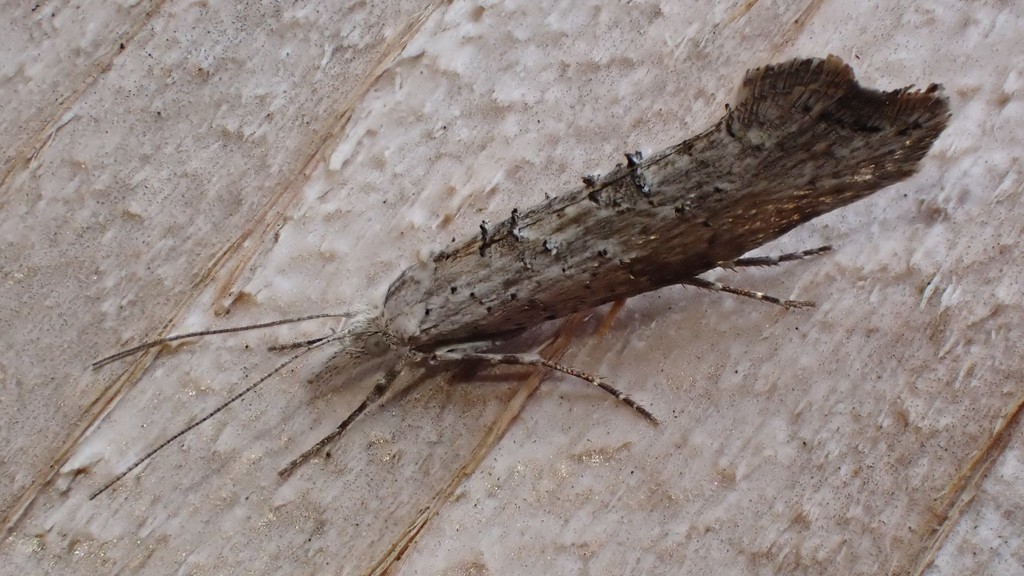
The moth has a wingspan of about 21 mm. Adults are seen flying from June through early October. It lives in many habitats such as mixed wood forests, river-bank areas and semi-arid scrub.
Source: Wikipedia
Size
Its wingspan measures roughly 21 mm.
Source: Wikipedia
Where it lives
It occupies mixed wood forests, riparian zones and semi-arid scrubland.
Source: Wikipedia
What it eats
The caterpillars feed on chokecherry (Prunus virginiana).
Source: Wikipedia
Life cycle
Pupation occurs inside an elongated silken cocoon.
Source: Wikipedia
When you see it
Adults are on the wing from June until the start of October.
Source: Wikipedia
Where it comes from
The species is found across much of North America, including Canadian provinces such as British Columbia, Alberta, Manitoba and Saskatchewan, and U.S. states like Michigan and Maryland.
Source: Wikipedia
Where it is found in the US
Recorded in 19 of 51 states and DC. Most records: Colorado, Montana, Washington, Vermont, Michigan, New York, Wisconsin, California.
Darker = more records. Counts are museum and citizen-science records, not population size.
Source: GBIF
Status: native in North America; native in Canada. Source: iNaturalist
Months it is reported in the US
Source: GBIF
More photos
Questions people ask
When can I see adult Ypsolopha falciferella?
Adults are active from June through early October.
Source: Wikipedia
What do the larvae eat?
The larvae feed on the leaves of chokecherry (Prunus virginiana).
Source: Wikipedia
Where does this moth live?
It inhabits mixed wood forests, riparian areas and semi-arid scrubland.
Source: Wikipedia
Same family (Ypsolophidae)



Sources
- Wikipedia: https://en.wikipedia.org/wiki/Ypsolopha_falciferella
Look it up elsewhere: GBIF · iNaturalist · BugGuide · Wikipedia
Text written 2026-10-29 from the sources above and checked sentence by sentence against them. Data fetched 2026-10-29.