 Bug FAQ
Yellow-girdled Brusheye
Dasysyrphus tricinctus · Order: Diptera · Family: Syrphidae
Also called: Yellow-girdled Fleckwing
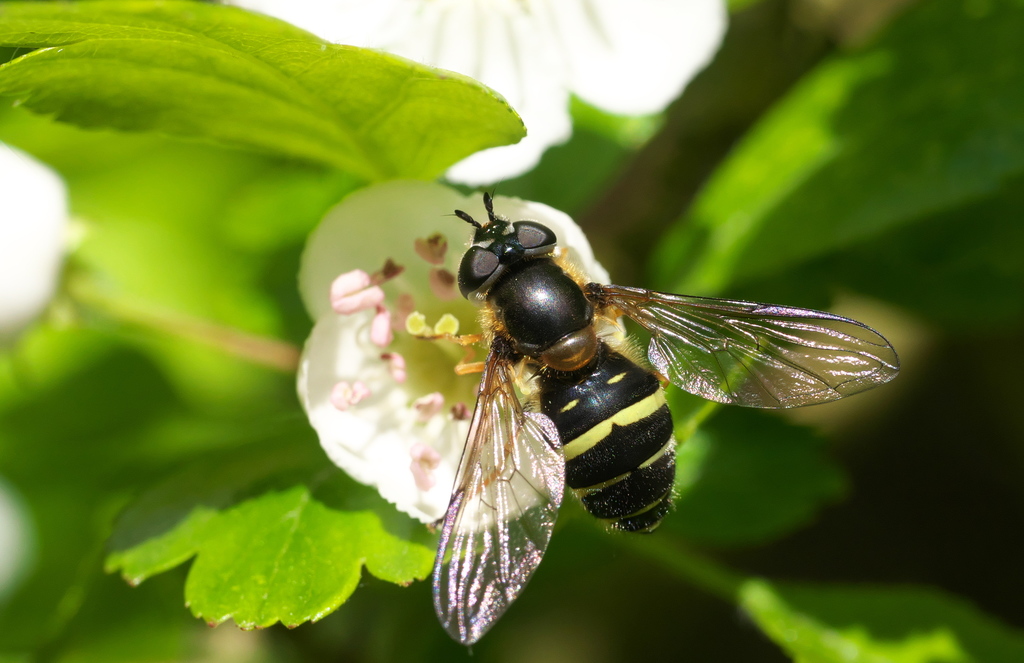
The Yellow-girdled Brusheye is a hoverfly with a wing length of about 7.3 to 10.3 mm and a black wing stigma. Its third abdominal segment has a broad yellow band, while the second segment shows little or no yellow. It lives in a wide range of forested habitats, from deciduous and coniferous woods to parkland and tracksides, and it comes down from trees to visit yellow composite and white umbellifer flowers.
Source: Wikipedia
How to recognize it
The wing stigma is black. Tergite 3 has a much broader yellow pattern than tergite 4, and tergite 2 has a small or absent yellow pattern.
Source: Wikipedia
Size
Wing length ranges from 7.25 mm to 10.25 mm.
Source: Wikipedia
Where it lives
Found in deciduous and coniferous forests, conifer plantations, Picea plantations, Betula scrub, tracksides, clearings, and parkland. Adults are arboreal but descend to feed on yellow composite and white umbellifer flowers.
Source: Wikipedia
What it eats
Larvae have been seen eating sawfly larvae on Picea and other Lepidoptera larvae.
Source: Wikipedia
Life cycle
The species flies from April to October, producing two generations per year.
Source: Wikipedia
When you see it
Peak adult numbers occur in late May to early June and again in late August to early September.
Source: Wikipedia
Where it comes from
Its range extends from Iceland south to the Pyrenees and northern Spain, across Ireland, Fennoscandia, Central and North Europe, through Russia to the Pacific coast and Japan.
Source: Wikipedia
Questions people ask
When are Yellow-girdled Brusheyes active?
Adults are on the wing from April through October, with two peaks in late May to early June and late August to early September.
Source: Wikipedia
What do the larvae eat?
The larvae feed on sawfly larvae found on spruce (Picea) and on other caterpillars (Lepidoptera).
Source: Wikipedia
Same family (Syrphidae)






Sources
- Wikipedia: https://en.wikipedia.org/wiki/Dasysyrphus_tricinctus
Look it up elsewhere: GBIF · iNaturalist · BugGuide · Wikipedia
Text written 2026-10-23 from the sources above and checked sentence by sentence against them. Data fetched 2026-10-23.