 Bug FAQ
Marmalade Hover Fly
Episyrphus balteatus · Order: Diptera · Family: Syrphidae
Also called: Marmalade Fly, Marmalade Hoverfly

The marmalade hoverfly is a small (9 to 12 mm) insect with orange-black bands on its abdomen and additional black markings on its thorax and dorsal plates. Adults visit flowers for pollen and nectar, while the larvae live on the ground and eat aphids, helping control cereal pests. They are common across Central Europe, can migrate seasonally, and sometimes form large swarms that look wasp-like.
Source: Wikipedia
How to recognize it
Males have eyes that meet at the top of the head.
Source: Wikipedia
Size
It measures about 9 to 12 mm in length.
Source: Wikipedia
Where it lives
You can find it year-round in gardens, parks and other urban green spaces where it feeds on flowers. Overwintering females often shelter on the sunny side of forest edges.
Source: Wikipedia
What it eats
Larvae live on the ground and eat aphids, consuming up to about 400 before turning into pupae. Adults feed on pollen and nectar and act as frequent pollinators, though not as efficiently as honey bees.
Source: Wikipedia
Life cycle
A larva can eat roughly 400 aphids before pupating. Some adults migrate south for the winter, while others overwinter as females in sheltered spots.
Source: Wikipedia
When you see it
In spring they arrive in Britain from continental Europe and leave again in late summer, often forming dense swarms that can alarm people.
Source: Wikipedia
Where it comes from
It is the most common native hoverfly in Central Europe.
Source: Wikipedia
Lookalikes
Their orange-black pattern mimics wasps, which can deter predators to an example of Batesian mimicry.
Source: Wikipedia
Where it is found in the US
Recorded in 2 of 51 states and DC. Most records: California, Virginia.
Darker = more records. Counts are museum and citizen-science records, not population size.
Source: GBIF
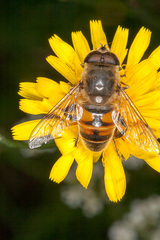
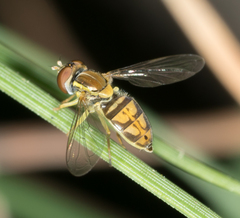
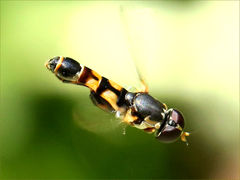
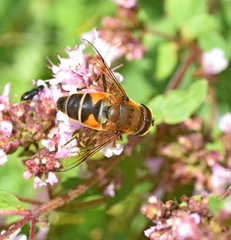
Same family (Syrphidae)


Sources
- Wikipedia: https://en.wikipedia.org/wiki/Episyrphus_balteatus
Look it up elsewhere: GBIF · iNaturalist · BugGuide · Wikipedia
Text written 2026-10-22 from the sources above and checked sentence by sentence against them. Data fetched 2026-10-22.