 Bug FAQ
Yellow Crazy Ant
Anoplolepis gracilipes · Order: Hymenoptera · Family: Formicidae
Also called: Ant, Longlegged Ant, long-legged ant
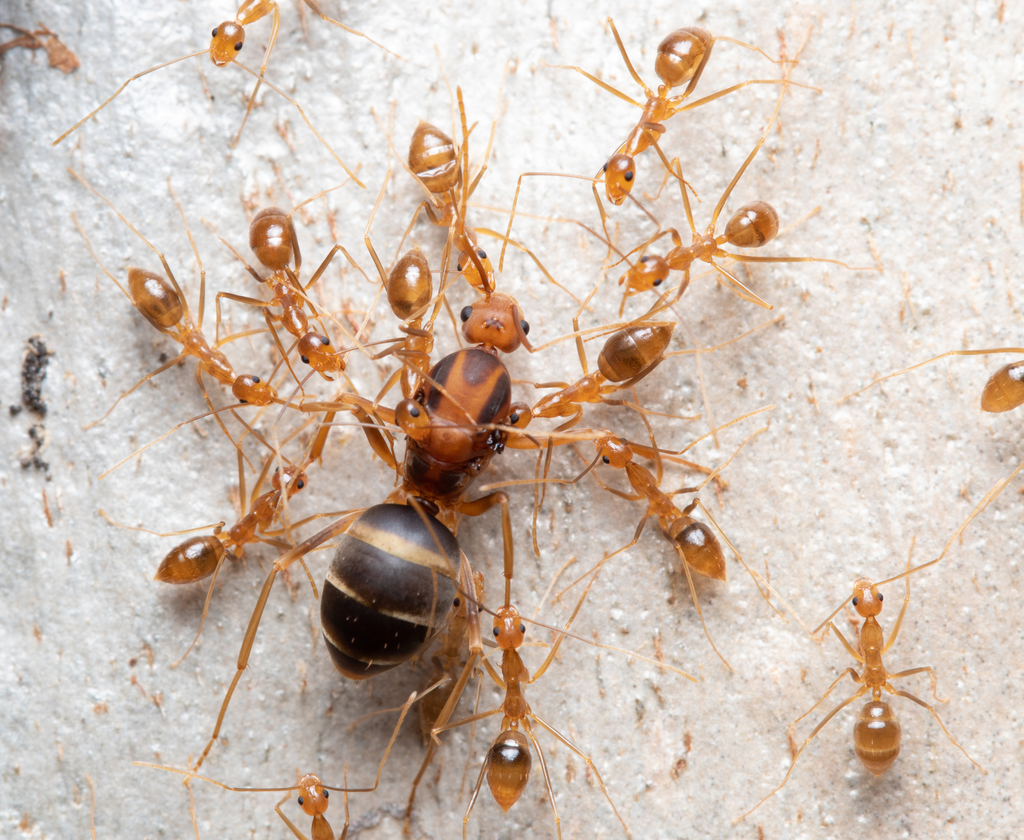
Yellow crazy ants are large, long-legged ants native to Asia that have spread to many tropical islands. They protect sap-feeding scale insects to harvest honeydew, and their colonies can become huge supercolonies. Control efforts have used aerial baiting, cutting colony numbers by 99% in some areas. They do not bite or sting. They spray formic acid to defend themselves and to subdue prey.
Source: Wikipedia
How to recognize it
The yellow crazy ant (Anoplolepis gracilipes) is also called the long-legged ant or Maldive ant.
Source: Wikipedia
Is it a pest in the house?
They do not bite or sting but can spray formic acid as a defense and to subdue prey. When disturbed by land crabs, they also spray formic acid as a defensive response.
Source: Wikipedia
Does it bite or sting?
They do not bite or sting; their defense is spraying formic acid.
Source: Wikipedia
How to get rid of it
In 2009, helicopters were used to bait supercolonies over 784 hectares, reducing ant densities by 99% after monthly monitoring.
Source: Wikipedia
Where it lives
It lives in moist tropical lowlands of Southeast Asia and nearby islands. It has been introduced to many tropical and subtropical places, including northern Australia, Caribbean islands, Indian Ocean islands, and Pacific islands.
Source: Wikipedia
What it eats
The ants harvest honeydew from scale insects, which they protect from predators.
Source: Wikipedia
Life cycle
A 2023 study suggested that male yellow crazy ants are obligate chimeras.
Source: Wikipedia
Where it comes from
It is thought to be native to Asia.
Source: Wikipedia
Lookalikes
Like other tramp ants, they are aggressive toward other ant species, tolerant of their own, and form large colonies.
Source: Wikipedia
Where it is found in the US
Recorded in 1 of 51 states and DC. Most records: Hawaii.
Darker = more records. Counts are museum and citizen-science records, not population size.
Source: GBIF
Status: introduced in North America; introduced in United States. Source: iNaturalist
Months it is reported in the US
Source: GBIF
More photos


Questions people ask
Do yellow crazy ants bite or sting?
No, they do not bite or sting; they defend themselves by spraying formic acid.
Source: Wikipedia
Where do these ants come from?
They are thought to be native to Asia and have spread to many tropical islands worldwide.
Source: Wikipedia
How are they controlled?
Aerial baiting with helicopters has been used to target supercolonies, achieving up to a 99% reduction in numbers.
Source: Wikipedia
Same family (Formicidae)
 Eastern Black Carpenter AntCamponotus pennsylvanicusCan damage your home
 Red Imported Fire AntSolenopsis invictaCan sting
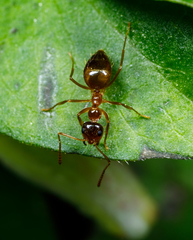 American Winter AntPrenolepis imparis
 Argentine AntLinepithema humileNuisance, not dangerous
 Immigrant Pavement AntTetramorium immigransCan sting
 Odorous House AntTapinoma sessileCan damage your home
Sources
- Wikipedia: https://en.wikipedia.org/wiki/Yellow_crazy_ant
Look it up elsewhere: GBIF · iNaturalist · BugGuide · ITIS · Wikipedia
Text written 2026-10-22 from the sources above and checked sentence by sentence against them. Data fetched 2026-10-22.