 Bug FAQ
Woolly-tailed Marsh Fly
Helophilus hybridus · Order: Diptera · Family: Syrphidae
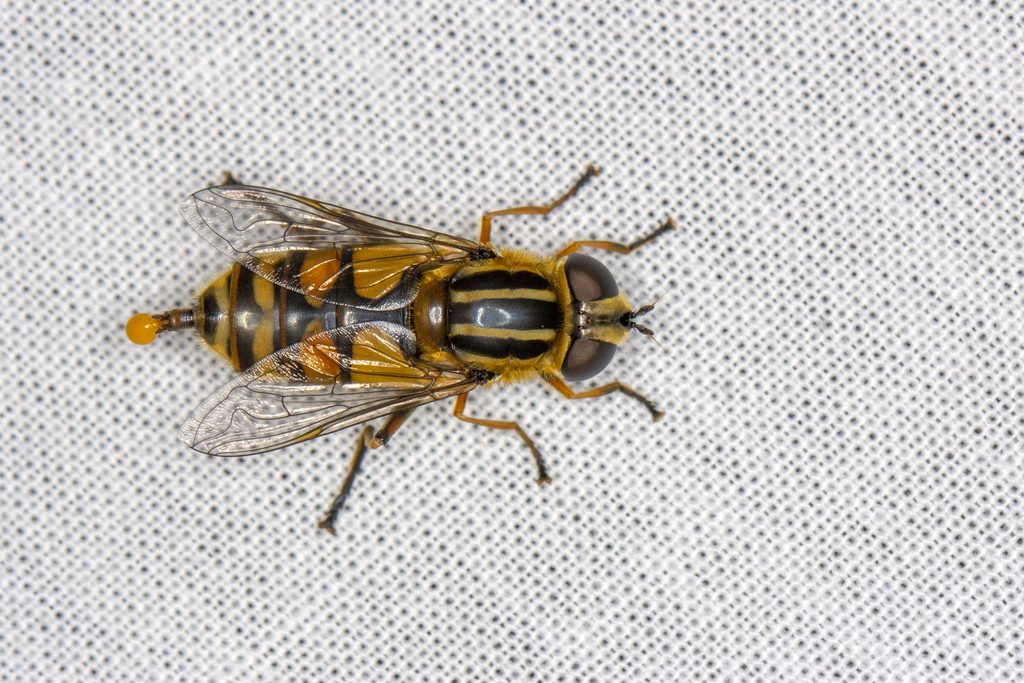
The woolly-tailed marsh fly has wings 8.5 to 11.3 mm long and the upper three femora are yellow on at most the front quarter, while the upper three tibiae are pale on at most the front quarter. It lives in non-eutrophic wetlands such as fens, poor fens, dune slacks, cut-over valley bogs, fen carrs and taiga, and it flies from early May to early September. Adults visit many flowers, including white umbellifers, heather, thistles, mint, willow, and many others, while its range covers the Palearctic from Fennoscandia to the Pacific coast of Russia.
Source: Wikipedia
How to recognize it
The top quarter of the upper three femora may be yellow, and the top quarter of the upper three tibiae may be pale.
Source: Wikipedia
Size
Wing length ranges from 8.5 mm to 11.25 mm.
Source: Wikipedia
Where it lives
Found in non-eutrophic wetlands such as fen pools, poor fen, deciduous woodland, dune slacks, cut-over valley bog, fen carr and taiga.
Source: Wikipedia
Life cycle
The flight period extends from early May to early September.
Source: Wikipedia
When you see it
Active from early May through early September.
Source: Wikipedia
Where it comes from
Native to the Palearctic, from Fennoscandia south to northern France, across Ireland, northern and central Europe, the Alps, east through Russia to the Far East and Siberian Pacific coast.
Source: Wikipedia
Where it is found in the US
Recorded in 13 of 51 states and DC. Most records: Alaska, Minnesota, North Dakota, Utah, Oregon, Washington, Colorado, Wyoming.
Darker = more records. Counts are museum and citizen-science records, not population size.
Source: GBIF
Status: native in North America; native in Canada. Source: iNaturalist
Months it is reported in the US
Source: GBIF
More photos

Same family (Syrphidae)


Sources
- Wikipedia: https://en.wikipedia.org/wiki/Helophilus_hybridus
Look it up elsewhere: GBIF · iNaturalist · BugGuide · ITIS · Wikipedia
Text written 2026-10-23 from the sources above and checked sentence by sentence against them. Data fetched 2026-10-22.