 Bug FAQ
White Spring Moth
Lomographa vestaliata · Order: Lepidoptera · Family: Geometridae

The white spring moth is a small Geometrid with a wingspan of about 15 to 23 mm and all-white, slightly translucent wings that have a fringed edge. It lives in dry, shrubby woodland edges across much of North America, from Newfoundland west to British Columbia and south to Florida, Texas and Mexico.
Source: Wikipedia
How to recognize it
Each wing has a fringe along its outer margin.
Source: Wikipedia
Size
Wingspan ranges from 15 to 23 mm.
Source: Wikipedia
Where it lives
Found on dry, shrubby edges of woodlands. Prefers xeric, dry climates.
Source: Wikipedia
When you see it
Adults are active during the day in spring.
Source: Wikipedia
Where it comes from
Native to North America, recorded from Newfoundland west to British Columbia and south to Florida, Texas and Mexico.
Source: Wikipedia
Lookalikes
Also called the white spring moth or spring faerie; it belongs to the family Geometridae.
Source: Wikipedia
Where it is found in the US
Recorded in 37 of 51 states and DC. Most records: Pennsylvania, Maryland, Ohio, Massachusetts, Vermont, West Virginia, North Carolina, Alabama.
Darker = more records. Counts are museum and citizen-science records, not population size.
Source: GBIF
Status: native in North America; native in United States; native in Canada. Source: iNaturalist
Months it is reported in the US
Source: GBIF
More photos
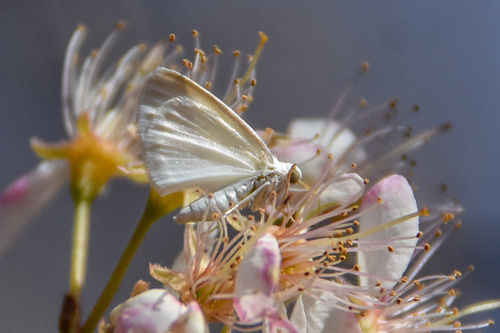
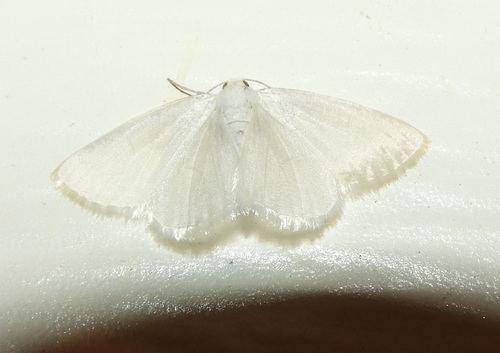
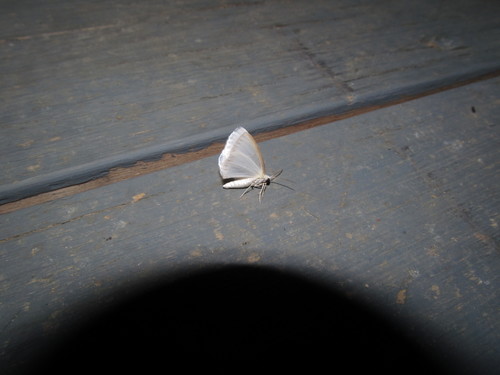
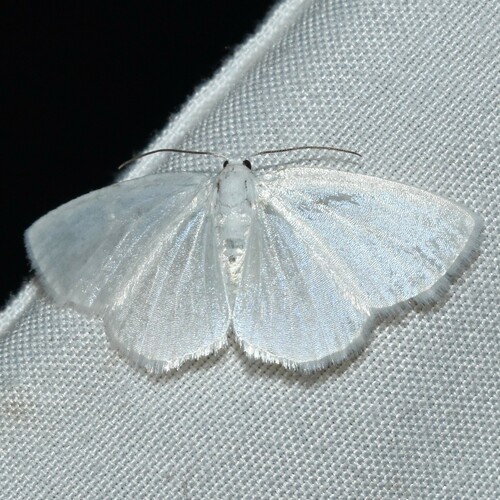
Questions people ask
Where can I find this moth?
It lives in dry, shrubby woodland edges across much of North America, from eastern Canada to the western United States and down to the Gulf Coast.
Source: Wikipedia
Same family (Geometridae)
 Willow BeautyPeribatodes rhomboidaria
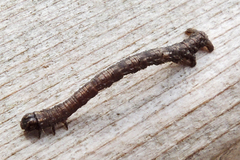 Pale BeautyCampaea perlataDamages trees, gardens or crops
 Large Lace-border MothScopula limboundataDamages trees, gardens or crops
 Riband WaveIdaea aversata
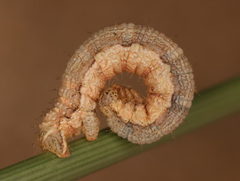 Yellow Shell MothCamptogramma bilineata
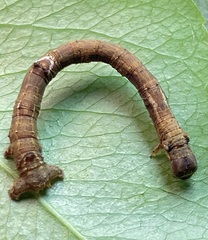 Large Maple Spanworm MothProchoerodes lineolaDamages trees, gardens or crops
Sources
- Wikipedia: https://en.wikipedia.org/wiki/Lomographa_vestaliata
Look it up elsewhere: GBIF · iNaturalist · BugGuide · ITIS · Wikipedia
Text written 2026-10-23 from the sources above and checked sentence by sentence against them. Data fetched 2026-10-23.