 Bug FAQ
Western Harvester Ant
Pogonomyrmex occidentalis · Order: Hymenoptera · Family: Formicidae
Source: Wikipedia
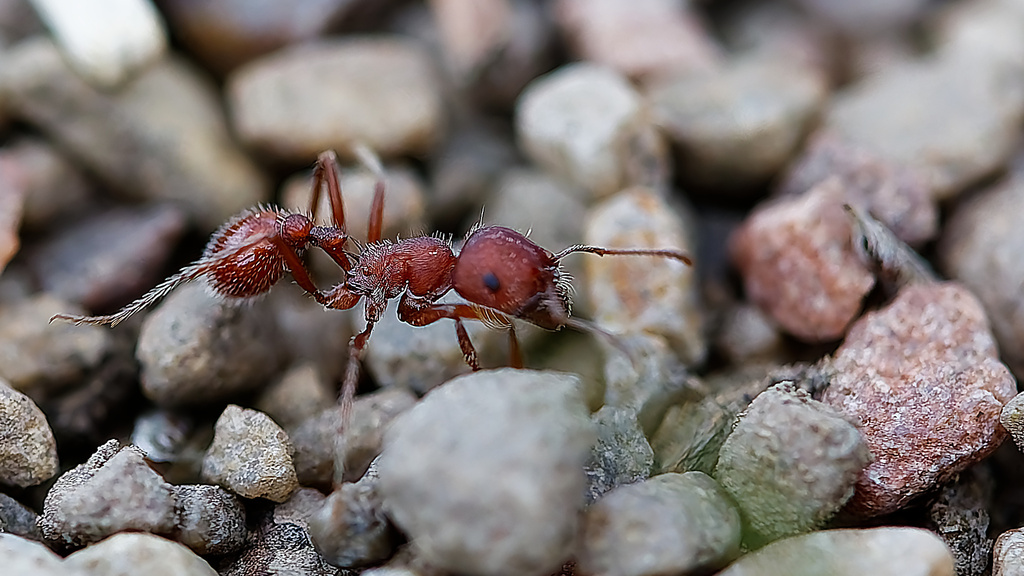
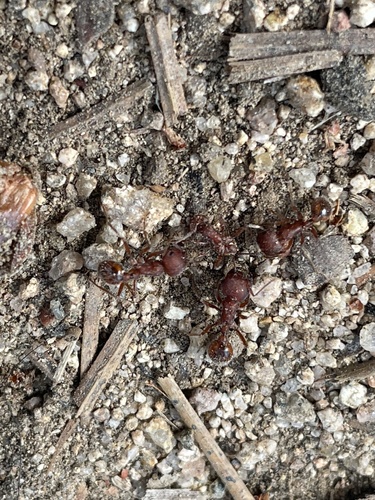
Western harvester ant workers are dark red and about 6 mm long. They build deep nests in desert and arid grassland soils and clear vegetation around their mounds. Workers harvest seeds, pollen and dead insects, and they defend their foraging area with a painful venomous sting.
Source: Wikipedia
How to recognize it
Workers have dark red bodies.
Source: Wikipedia
Size
Mature workers average about 6 mm in length.
Source: Wikipedia
Does it bite or sting?
They have a painful, venomous sting. Workers defend their foraging territory against neighboring colonies.
Source: Wikipedia
Where it lives
They live in deserts and arid grasslands of the western United States and Canada, usually below 1,900 m elevation. A colony’s nest can be as deep as 5 m.
Source: Wikipedia
What it eats
Workers collect seeds and pollen directly from plants and also gather fallen seeds. They also pick up newly dead insects.
Source: Wikipedia
Life cycle
A queen may live up to 30 years and colonies often persist for about 20 years.
Source: Wikipedia
When you see it
Foraging activity occurs from April through September. Workers are active when surface temperatures of their mound are between 25 °C and 53 °C.
Source: Wikipedia
Where it comes from
The species is characteristic of the interior western United States.
Source: Wikipedia
Where it is found in the US
Recorded in 19 of 51 states and DC. Most records: Utah, Colorado, New Mexico, Arizona, Nebraska, Wyoming, Nevada, Montana.
Darker = more records. Counts are museum and citizen-science records, not population size.
Source: GBIF
Status: native in North America; native in Canada; native in United States. Source: iNaturalist
Months it is reported in the US
Source: GBIF
More photos
Questions people ask
When are they active?
They forage from April to September and are active at mound surface temperatures of 25 to 53 °C.
Source: Wikipedia
Same family (Formicidae)
 Eastern Black Carpenter AntCamponotus pennsylvanicusCan damage your home
 Red Imported Fire AntSolenopsis invictaCan sting
 American Winter AntPrenolepis imparis
 Argentine AntLinepithema humileNuisance, not dangerous
 Immigrant Pavement AntTetramorium immigransCan sting
 Odorous House AntTapinoma sessileCan damage your home
Sources
- Wikipedia: https://en.wikipedia.org/wiki/Pogonomyrmex_occidentalis
Look it up elsewhere: GBIF · iNaturalist · BugGuide · ITIS · Wikipedia
Text written 2026-10-23 from the sources above and checked sentence by sentence against them. Data fetched 2026-10-22.