 Bug FAQ
Virginia Giant Hover Fly
Milesia virginiensis · Order: Diptera · Family: Syrphidae
Also called: Virginia Flower Fly, Yellowjacket Hover Fly
Source: Wikipedia

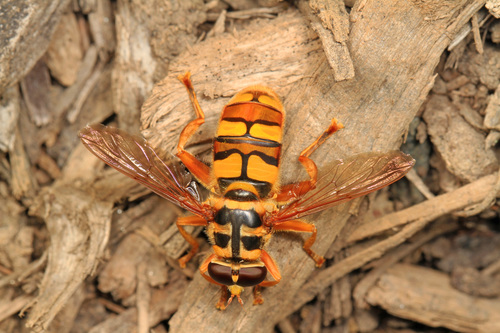
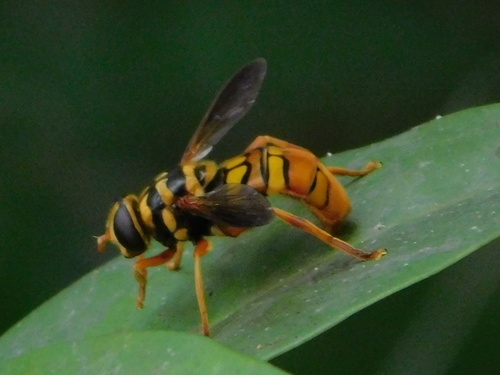
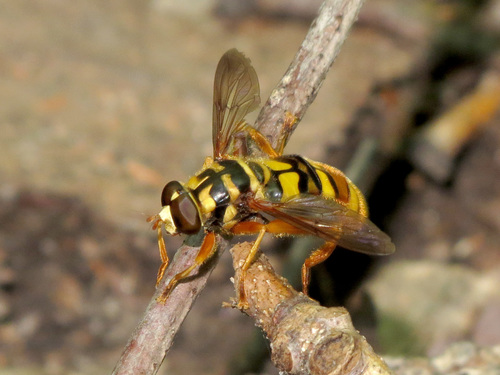
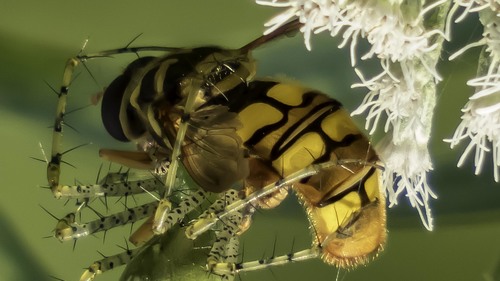
The Virginia Giant Hover Fly is 18 to 21 mm long and lives at forest edges and meadows. Adults feed on nectar and pollen in mid-summer to early fall, while larvae eat decaying plant matter. It mimics yellow-jackets or European hornets in appearance but cannot sting.
Source: Wikipedia
How to recognize it
It looks like a stinging yellow-jacket or European hornet to deter predators.
Source: Wikipedia
Size
It measures about 18 to 21 mm (0.71 to 0.83 in).
Source: Wikipedia
Does it bite or sting?
It cannot sting and poses no bite risk.
Source: Wikipedia
Where it lives
It is found on forest edges and in meadows.
Source: Wikipedia
What it eats
Adults mainly sip nectar and collect pollen; larvae feed on decaying plant material.
Source: Wikipedia
Life cycle
Adults hover and make erratic movements before flying away.
Source: Wikipedia
When you see it
Adults are active from mid-summer through early fall.
Source: Wikipedia
Where it comes from
Its range includes the United States, Ontario in Canada, and Mexico.
Source: Wikipedia
Lookalikes
Its coloration mimics stinging yellow-jackets or European hornets.
Source: Wikipedia
Where it is found in the US
Recorded in 36 of 51 states and DC. Most records: North Carolina, Virginia, Tennessee, Georgia, Texas, Alabama, Arkansas, Ohio.
Darker = more records. Counts are museum and citizen-science records, not population size.
Source: GBIF
Status: native in North America; native in United States; native in Canada. Source: iNaturalist
Months it is reported in the US
Source: GBIF
More photos
Questions people ask
Same family (Syrphidae)






Sources
- Wikipedia: https://en.wikipedia.org/wiki/Milesia_virginiensis
Look it up elsewhere: GBIF · iNaturalist · BugGuide · ITIS · Wikipedia
Text written 2026-10-23 from the sources above and checked sentence by sentence against them. Data fetched 2026-10-22.