 Bug FAQ
V-Pug
Chloroclystis v-ata · Order: Lepidoptera · Family: Geometridae

The V-Pug is a small moth about 14 to 19 mm long, with green forewings that show a distinctive V-shaped black mark and grey-white hindwings. It lives across the Palearctic, the Near East and North Africa and is common throughout most of the British Isles except northern Scotland. Adults appear from May to August, with one or two generations per year, and the species overwinters as a pupa.
Source: Wikipedia
How to recognize it
Newly emerged adults have green forewings marked by a V-shaped black crossline, while the hindwings are greyish-white.
Source: Wikipedia
Where it lives
In the British Isles it is widespread except in northern Scotland.
Source: Wikipedia
What it eats
The green larvae, usually with three reddish stripes, feed on the flowers of many plant species.
Source: Wikipedia
Life cycle
The species produces one or two broods each year, with adults on the wing from May to August. It overwinters in the pupal stage.
Source: Wikipedia
Where it comes from
Its native range includes the Palearctic, the Near East and North Africa.
Source: Wikipedia
Lookalikes
Even though the green colour fades, the small size, distinctive markings and triangular resting posture make it easy to identify.
Source: Wikipedia
Questions people ask
When are V-Pug moths active?
Adults are active from May through August, with one or two generations per year.
Source: Wikipedia
What do V-Pug caterpillars eat?
The caterpillars feed on the flowers of a wide variety of plants.
Source: Wikipedia
Where can I find V-Pug moths?
They occur across the Palearctic, the Near East, North Africa, and most of the British Isles except northern Scotland.
Source: Wikipedia
Same family (Geometridae)
 Willow BeautyPeribatodes rhomboidaria
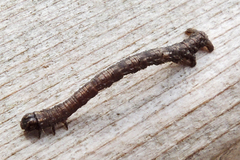 Pale BeautyCampaea perlataDamages trees, gardens or crops
 Large Lace-border MothScopula limboundataDamages trees, gardens or crops
 Riband WaveIdaea aversata
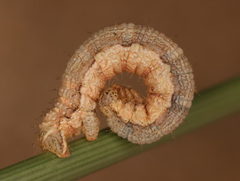 Yellow Shell MothCamptogramma bilineata
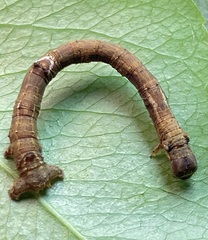 Large Maple Spanworm MothProchoerodes lineolaDamages trees, gardens or crops
Sources
- Wikipedia: https://en.wikipedia.org/wiki/V-pug
Look it up elsewhere: GBIF · iNaturalist · BugGuide · Wikipedia
Text written 2026-10-22 from the sources above and checked sentence by sentence against them. Data fetched 2026-10-22.