 Bug FAQ
Turf Running Spider
Philodromus cespitum · Order: Araneae · Family: Philodromidae
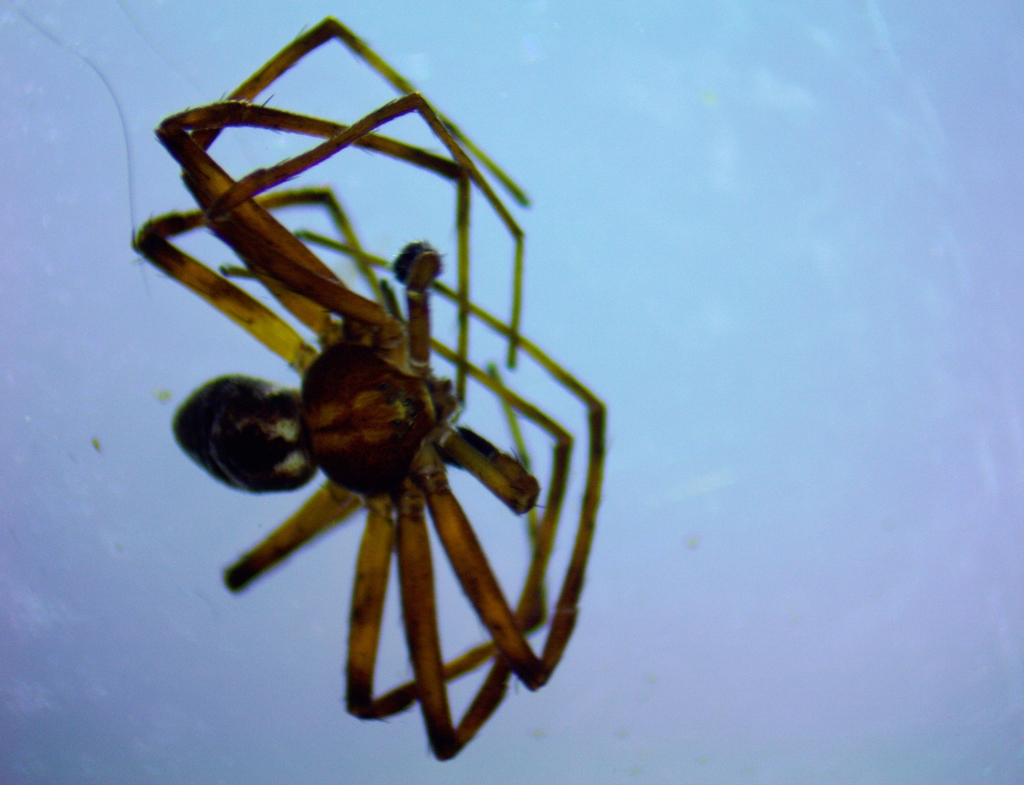
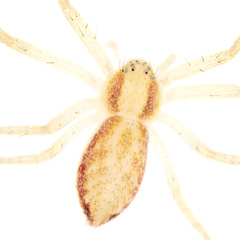
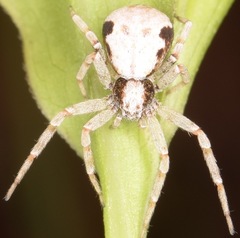
The turf running spider is a small, brown or yellowish spider that often has spots on its body and sometimes on its legs. Males measure about 3.5 to 5 mm, while females are roughly 5.3 mm long, and males usually show more spots than females. It lives on foliage in fruit orchards across Europe, North America, North Africa, the Middle East and parts of Asia, where it preys on orchard insects and other spiders.
Source: Wikipedia
How to recognize it
The spider’s body color ranges from brown to yellow, often with spots. Legs are typically yellow-brown or grey, and some individuals have spots on their legs.
Source: Wikipedia
Size
Males are about 3.5 to 5 mm long, and females are around 5.3 mm.
Source: Wikipedia
Where it lives
It lives on foliage and is the most common spider in European fruit orchards.
Source: Wikipedia
What it eats
It hunts insects such as aphids and the pest Cacopsylla pyri, as well as other spiders like Theridion species. It may also eat smaller competing spiders in a behavior called intraguild predation.
Source: Wikipedia
Life cycle
Females lay about 250 eggs, arranging them in five to seven cocoons. Eggs hatch in roughly 20 days at 15 °C and about 10 days at 24 °C.
Source: Wikipedia
When you see it
Adult females are most often seen in June and July. Spiderlings can be found year-round, with peak numbers from August to October.
Source: Wikipedia
Where it is found in the US
Recorded in 21 of 51 states and DC. Most records: Colorado, Ohio, Minnesota, Alaska, North Dakota, Wyoming, Wisconsin, Maine.
Darker = more records. Counts are museum and citizen-science records, not population size.
Source: GBIF
Status: native in North America; native in United States; native in Canada. Source: iNaturalist
Months it is reported in the US
Source: GBIF
More photos
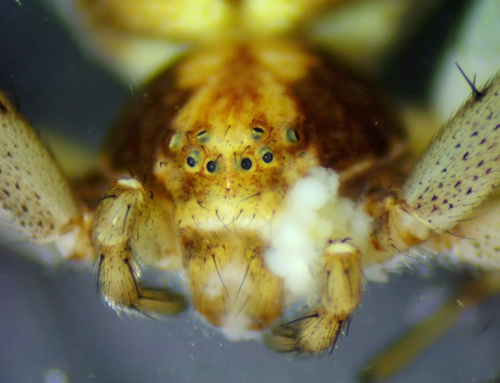
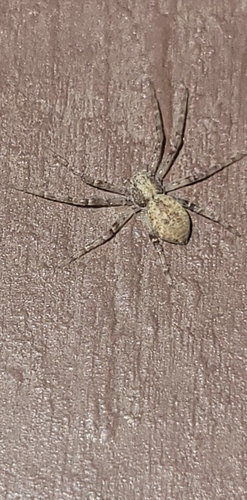
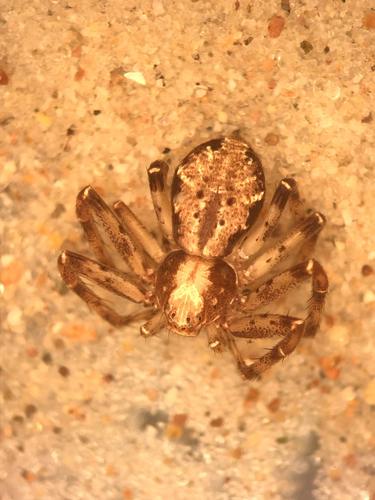
Questions people ask
How can I recognize a turf running spider?
Look for a small brown or yellow spider about 3 to 5 mm long, often with spots on its body and sometimes on its legs; males usually have more spots than females.
Source: Wikipedia
Where might I find this spider in my garden?
It lives on plant foliage and is especially common in fruit orchards and other leafy areas.
Source: Wikipedia
What does this spider eat?
It preys on orchard insects like aphids and the pest Cacopsylla pyri, and also hunts other spiders.
Source: Wikipedia
When are they most active?
Adult females are most often seen in June and July, while spiderlings are most abundant from August to October.
Source: Wikipedia
Same family (Philodromidae)



Sources
- Wikipedia: https://en.wikipedia.org/wiki/Philodromus_cespitum
Look it up elsewhere: GBIF · iNaturalist · BugGuide · ITIS · Wikipedia
Text written 2026-10-25 from the sources above and checked sentence by sentence against them. Data fetched 2026-10-25.