 Bug FAQ
Trivittate Marsh Fly
Helophilus trivittatus · Order: Diptera · Family: Syrphidae
Also called: Trivittate Sun Fly, Large Tiger Hoverfly
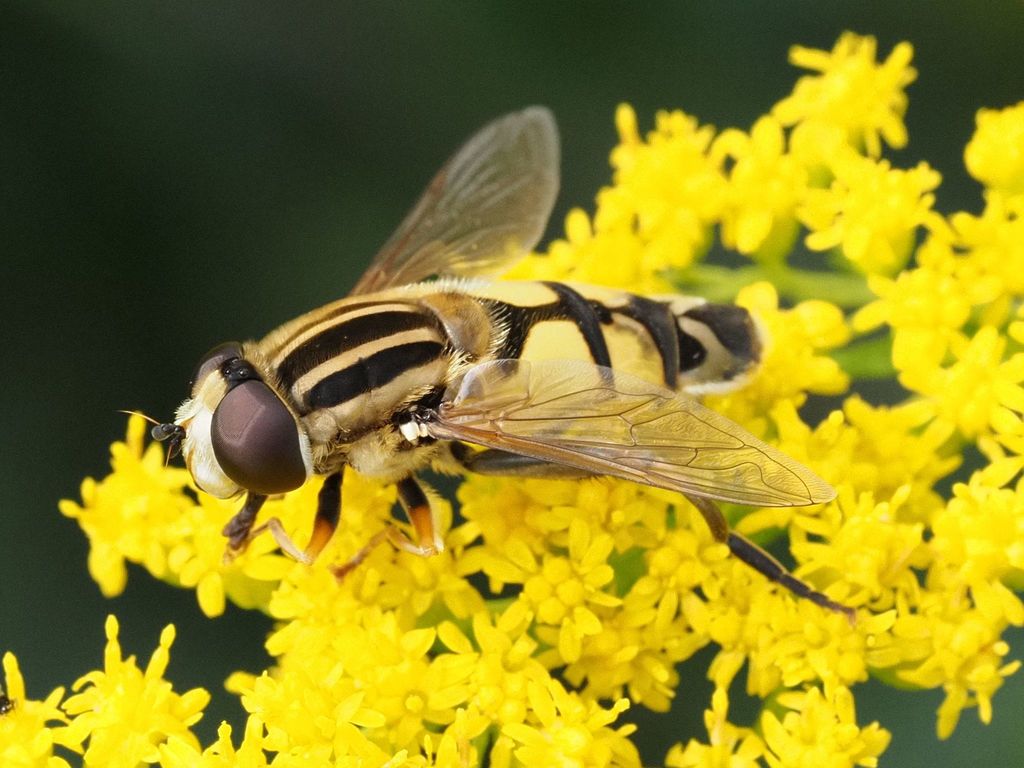
The Trivittate Marsh Fly is a medium-sized hoverfly with a wing length of about 10 to 12 mm. It has a distinctive face stripe that is wide and yellow, sometimes with a central reddish-brown line, and its thorax shows alternating narrow yellow and broader dark brown stripes. Adults visit many flowers for nectar, while the larvae live in decaying plant material such as cattail rhizomes and reeds.
Source: Wikipedia
How to recognize it
Face: a broad yellow stripe, possibly with a central reddish-brown stripe. Thorax: four narrow pale yellow stripes alternating with three wider dark brown stripes.
Source: Wikipedia
Size
Wing length ranges from 10.25 to 12.25 mm (0.404 to 0.482 in).
Source: Wikipedia
Where it lives
Found in wetlands, river edges, seasonally flooded grasslands and salt-marshes. In southern Europe it often frequents irrigation ditches on farmland.
Source: Wikipedia
What it eats
Adults feed on a wide variety of flowers, including umbellifers, composites, Aster, Crataegus, Mentha, Ranunculus, Salix and many others. Larvae are detritivores that live in decaying rhizomes of cattails (Typha latifolia) and in beds of giant reed (Glyceria maxima).
Source: Wikipedia
Life cycle
Adults are on the wing from May through October.
Source: Wikipedia
When you see it
Flight period extends from May to October.
Source: Wikipedia
Where it comes from
Present across most of Europe and the eastern Palearctic, from Fennoscandia to the Mediterranean and east to Siberia and the Russian Far East.
Source: Wikipedia
Lookalikes
It is a Palearctic hoverfly; identification details are in specialist references.
Source: Wikipedia
More photos

Same family (Syrphidae)






Sources
- Wikipedia: https://en.wikipedia.org/wiki/Helophilus_trivittatus
Look it up elsewhere: GBIF · iNaturalist · BugGuide · Wikipedia
Text written 2026-10-22 from the sources above and checked sentence by sentence against them. Data fetched 2026-10-22.