 Bug FAQ
Tree Damsel Bug
Himacerus apterus · Order: Hemiptera · Family: Nabidae
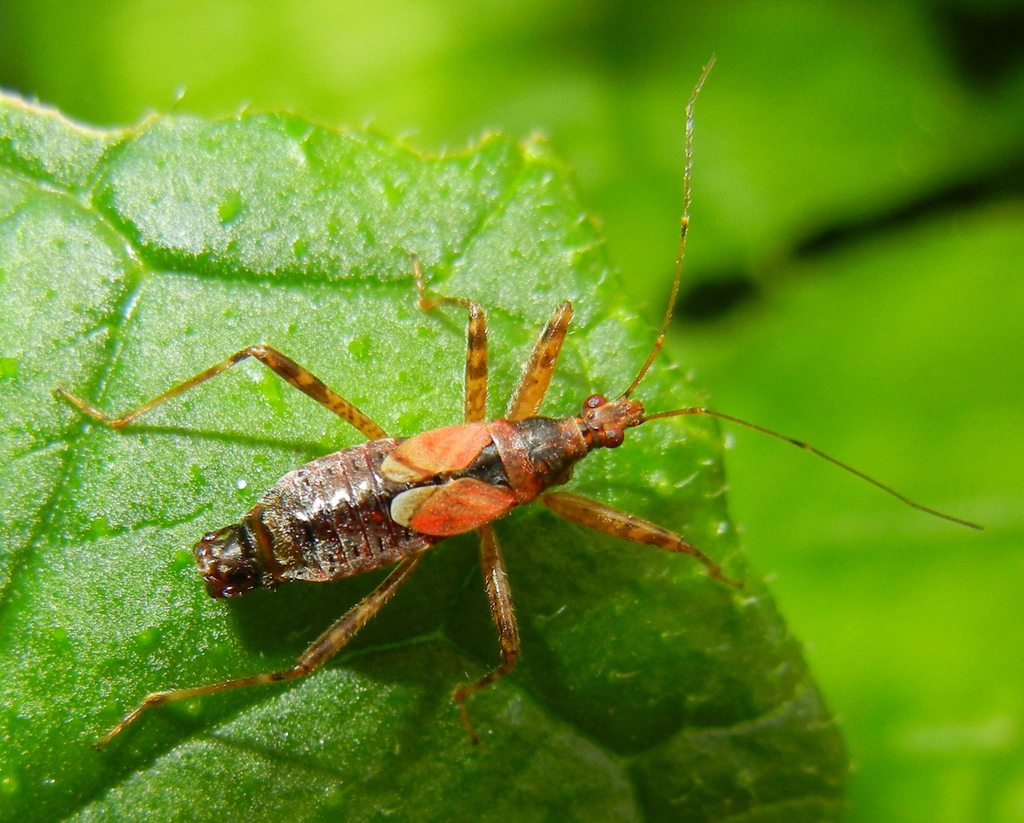
Tree Damsel Bugs are small true bugs about 8 to 11 mm long, with black edges on the abdomen and orange-red spots on reddish-brown wings. They live across most of Europe, southern and central Asia, and have been recorded in eastern Nova Scotia in the mid-20th century. Adults lay eggs on plant stems in late summer; larvae appear from May to August and the bugs feed on mites, aphids and other tiny insects.
Source: Wikipedia
How to recognize it
The bug has a black connexivum and orange-red spots on reddish-brown wings.
Source: Wikipedia
Size
Males measure 8 to 10.5 mm and females 9 to 11.5 mm in length. The wingspan ranges from 8 to 10 mm.
Source: Wikipedia
Where it lives
It occurs throughout most of Europe and in southern and central Asia. From 1943 to 1989 it was also found in eastern Nova Scotia.
Source: Wikipedia
What it eats
It preys on mites, aphids and other small insects.
Source: Wikipedia
Life cycle
Adults lay eggs on plant stems in late summer; the eggs hatch in spring. Larvae are present from May through August.
Source: Wikipedia
When you see it
Larvae are found from May to August.
Source: Wikipedia
Where it is found in the US
Recorded in 1 of 51 states and DC. Most records: Washington.
Darker = more records. Counts are museum and citizen-science records, not population size.
Source: GBIF
Status: introduced in Canada. Source: iNaturalist
More photos


Questions people ask
Where can I find Tree Damsel Bugs?
They are common across most of Europe, southern and central Asia, and were recorded in eastern Nova Scotia between 1943 and 1989.
Source: Wikipedia
Same family (Nabidae)
Sources
- Wikipedia: https://en.wikipedia.org/wiki/Himacerus_apterus
Look it up elsewhere: GBIF · iNaturalist · BugGuide · ITIS · Wikipedia
Text written 2026-10-22 from the sources above and checked sentence by sentence against them. Data fetched 2026-10-22.