 Bug FAQ
Treble Lines
Charanyca trigrammica · Order: Lepidoptera · Family: Noctuidae
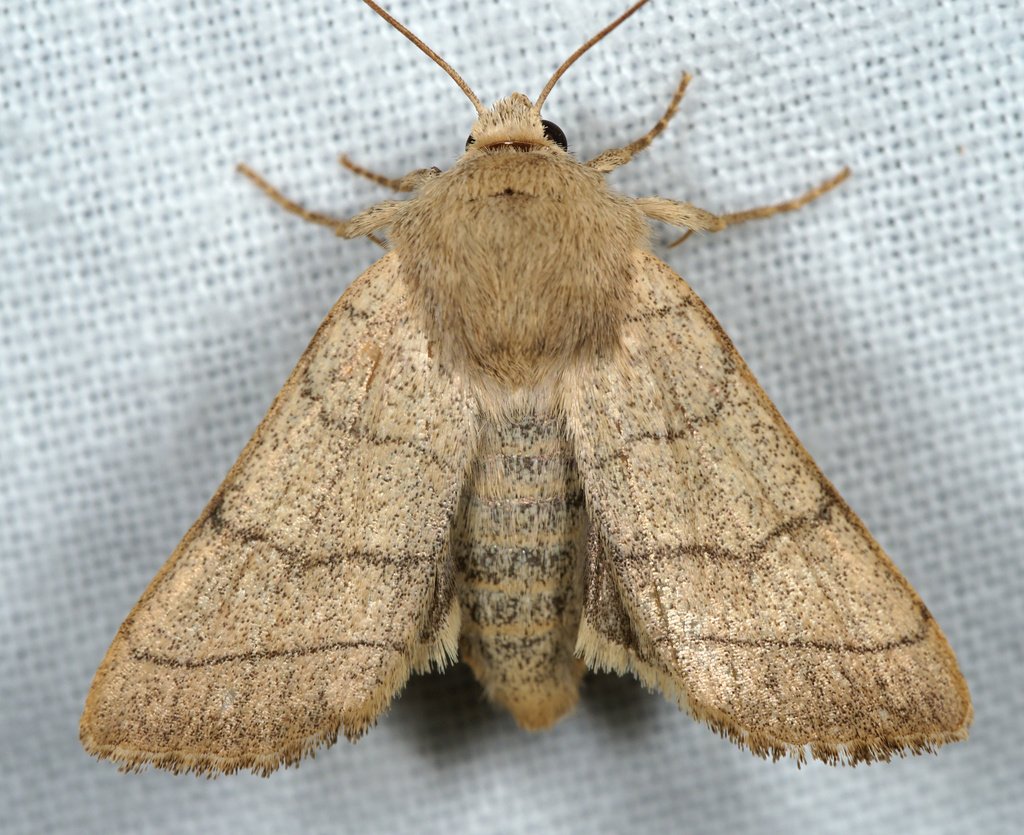
The treble lines moth has a wingspan of about 35 to 40 mm and pale to dark grey hindwings. It lives across most of Europe, also in Asia Minor and the Caucasus, up to 1000 m in the mountains. Caterpillars feed on herbaceous plants such as Plantago major and the adult flies from April to July in one generation.
Source: Wikipedia
How to recognize it
Forewings are whitish-ochre with fine olive-brown dusting, three brown cross-lines and a darker shade near the edge; hindwings range from pale to dark grey.
Source: Wikipedia
Size
Wingspan measures 35 to 40 mm (1.4 to 1.6 in).
Source: Wikipedia
Where it lives
Found throughout Europe, also in Asia Minor and the Caucasus, up to 1000 m altitude in mountains.
Source: Wikipedia
What it eats
Caterpillars prefer herbaceous plants, especially Plantago major.
Source: Wikipedia
Life cycle
Eggs are flattened, ribbed spheres, yellow-white in colour. Larvae are stocky, grey to reddish, with many warts, short hairs and a bright broken dorsal line. Adults fly in a single generation from April to July.
Source: Wikipedia
When you see it
The moth is on the wing from April through July.
Source: Wikipedia
Where it comes from
Its range covers virtually all of Europe, plus parts of Asia Minor and the Caucasus.
Source: Wikipedia
Lookalikes
Several forms resemble it, such as bilinea (reddish-grey wing), perrufa (rufous wing), obscura (olive-fuscous), pallidalinea (inner line missing), semifuscans (half dark), fringsii (single line), and erubescens (dark brown from Sicily).
Source: Wikipedia
More photos


Same family (Noctuidae)
 Ipsilon Dart MothAgrotis ipsilonDamages trees, gardens or crops
 Fall Armyworm MothSpodoptera frugiperdaDamages trees, gardens or crops
 Army Cutworm MothEuxoa auxiliarisDamages trees, gardens or crops
 Large Yellow UnderwingNoctua pronubaDamages trees, gardens or crops
 Silver ΥAutographa gamma
 American DaggerAcronicta americanaCan irritate skin
Sources
- Wikipedia: https://en.wikipedia.org/wiki/Charanyca_trigrammica
Look it up elsewhere: GBIF · iNaturalist · BugGuide · Wikipedia
Text written 2026-10-22 from the sources above and checked sentence by sentence against them. Data fetched 2026-10-22.