 Bug FAQ
Transverse-banded Flower Fly
Eristalis transversa · Order: Diptera · Family: Syrphidae

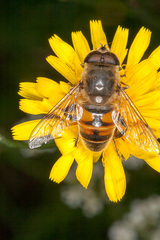
The transverse-banded flower fly is 7 to 12 mm long and has a black thorax with three gray-olive bands. Adults hover near flowers to sip nectar and eat pollen, and they can hover almost motionless in flight. It is found east of the Mississippi River in North America and into southeastern Canada.
Source: Wikipedia
How to recognize it
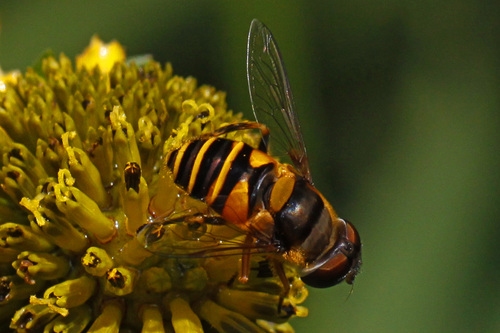
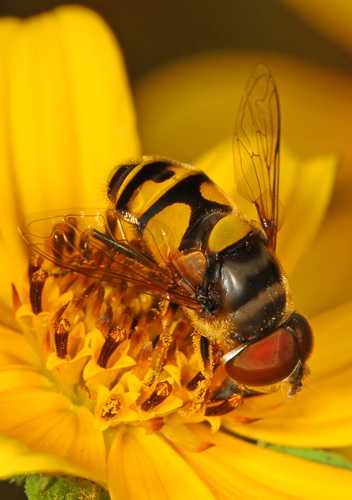
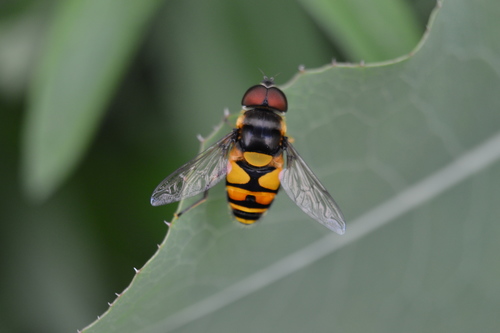
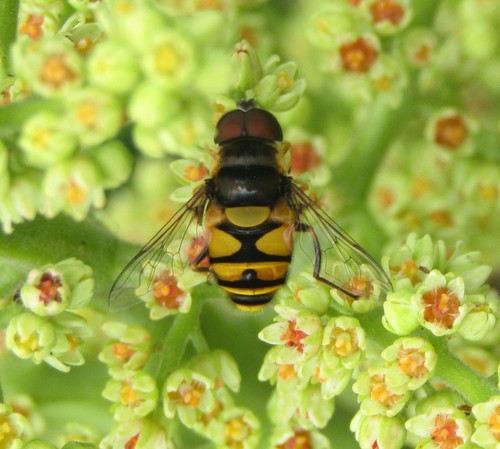
The thorax (notum) is solid black with three transverse gray-olive bands. The abdomen has three segments: the first is black; the second shows large yellow side triangles (smaller in females) and a narrow yellow rear ring on a black background; the third has side yellow spots linked by a yellow ring and a yellow rear border on black.
Source: Wikipedia
Size
Body length ranges from about 7 to 12 mm (0.28 to 0.47 in).
Source: Wikipedia
Where it lives
Adults are commonly seen on flowers where they feed on nectar and pollen.
Source: Wikipedia
What it eats
Adults obtain energy from flower nectar and protein from pollen.
Source: Wikipedia
Life cycle
Hoverflies can hover almost motionless while flying. The larvae are of the rat-tailed type, though this species' larvae have not been specifically reported.
Source: Wikipedia
Lookalikes
Hoverflies are known for their ability to hover nearly motionless in flight.
Source: Wikipedia
Where it is found in the US
Recorded in 38 of 51 states and DC. Most records: New York, Ohio, Massachusetts, Virginia, Illinois, Pennsylvania, Vermont, Maryland.
Darker = more records. Counts are museum and citizen-science records, not population size.
Source: GBIF
Status: native in North America; native in United States; native in Canada. Source: iNaturalist
Months it is reported in the US
Source: GBIF
More photos
Same family (Syrphidae)


Sources
- Wikipedia: https://en.wikipedia.org/wiki/Eristalis_transversa
Look it up elsewhere: GBIF · iNaturalist · BugGuide · ITIS · Wikipedia
Text written 2026-10-22 from the sources above and checked sentence by sentence against them. Data fetched 2026-10-22.