 Bug FAQ
Tohono Vinegaroon
Mastigoproctus tohono · Order: Uropygi · Family: Thelyphonidae
Source: Wikipedia
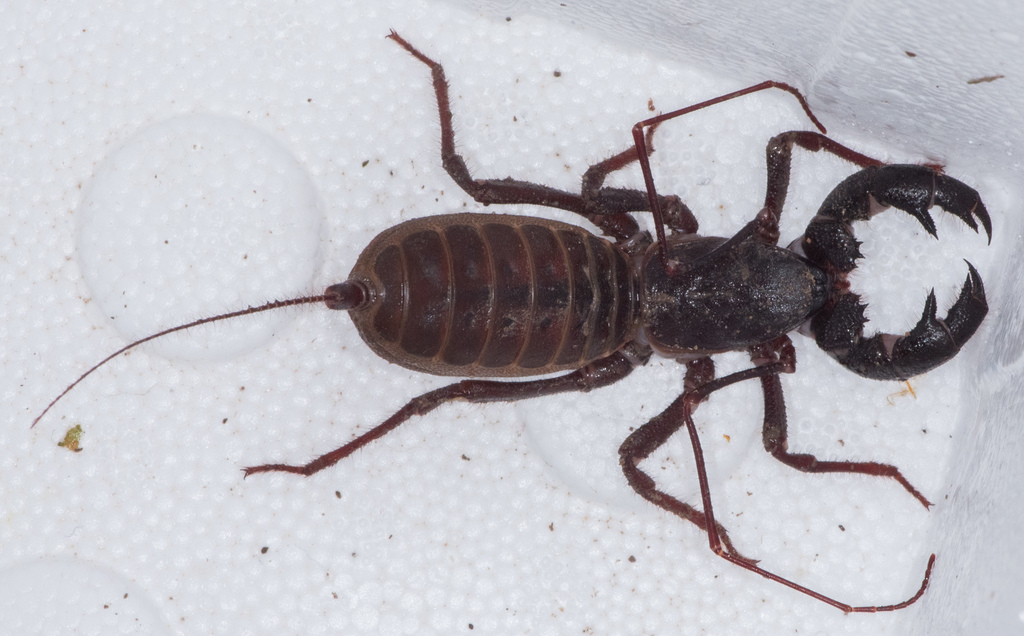
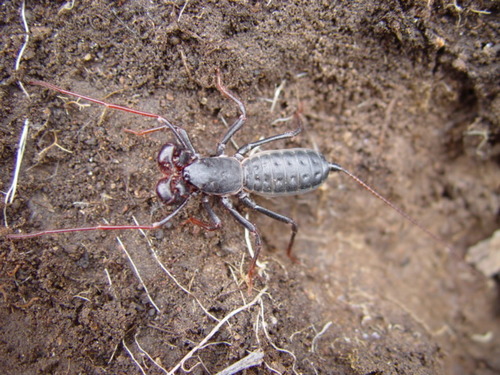
The Tohono Vinegaroon grows about 56-59 mm long, not counting its tail. Its body is dark reddish-brown to black, while the front legs that look like antennae are reddish-brown.
Source: Wikipedia
How to recognize it
The carapace ranges from dark reddish brown to black, and the antenniform front legs are usually reddish brown.
Source: Wikipedia
Size
Adults measure 56 to 59 mm in length, excluding the tail.
Source: Wikipedia
What it eats
It uses six walking legs and two sensory front legs to detect prey, then captures and crushes prey with claw-like pedipalps.
Source: Wikipedia
Where it comes from
Its native range extends from northern Sonora, Mexico, into southern Arizona and western New Mexico.
Source: Wikipedia
Lookalikes
It is commonly called the Tohono whip scorpion and belongs to the Uropygid group with a distinctive shape and defensive spray.
Source: Wikipedia
Where it is found in the US
Recorded in 2 of 51 states and DC. Most records: Arizona, New Mexico.
Darker = more records. Counts are museum and citizen-science records, not population size.
Source: GBIF
Months it is reported in the US
Source: GBIF
More photos
Questions people ask
How big does a Tohono Vinegaroon get?
Adults are about 56-59 mm long, not counting the tail.
Source: Wikipedia
Where is the Tohono Vinegaroon found?
It lives from northern Sonora, Mexico, through southern Arizona and western New Mexico, especially in the Chiricahua and Huachuca Mountains.
Source: Wikipedia
Same family (Thelyphonidae)
Sources
- Wikipedia: https://en.wikipedia.org/wiki/Mastigoproctus_tohono
Look it up elsewhere: GBIF · iNaturalist · BugGuide · ITIS · Wikipedia
Text written 2026-10-23 from the sources above and checked sentence by sentence against them. Data fetched 2026-10-23.