 Bug FAQ
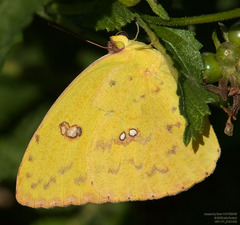
Three-spotted Grass Yellow
Eurema blanda · Order: Lepidoptera · Family: Pieridae
Also called: Papuan Grass-yellow, Three Spot Grass Yellow
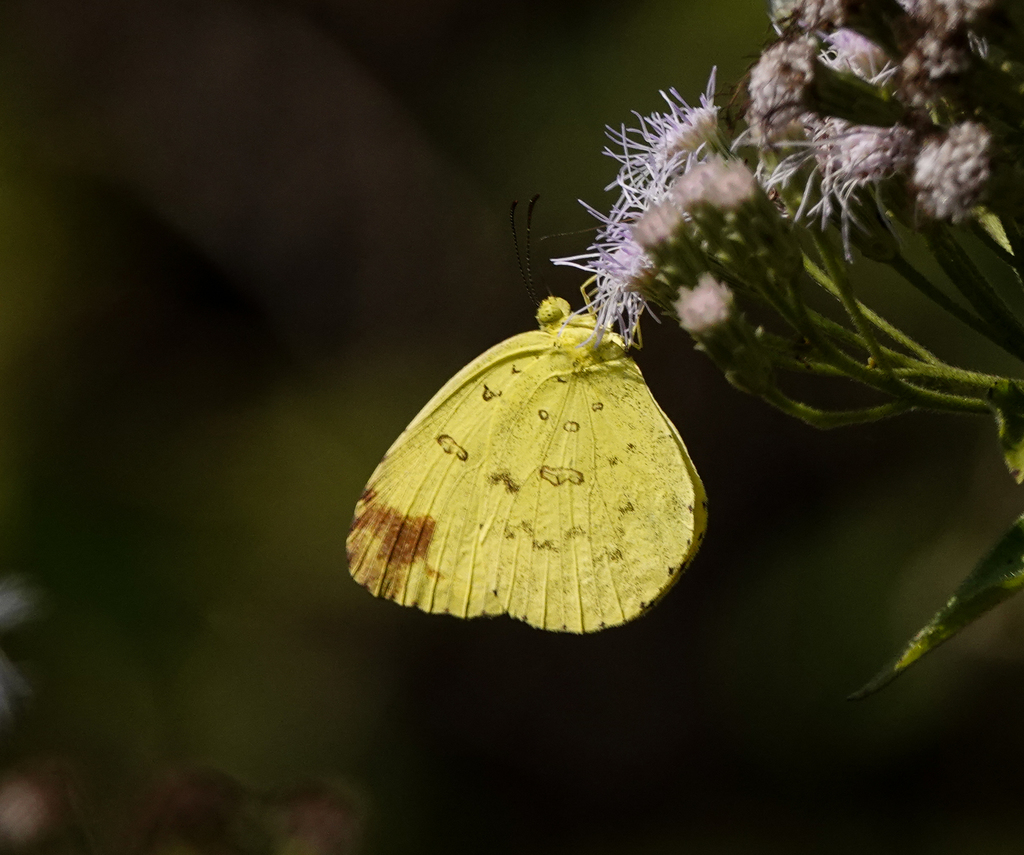
Its caterpillars feed on Caesalpinia mimosoides and Bauhinia purpurea, and its life cycle runs from eggs (about three days to hatch) through green larvae (about 20 days) to green pupae that emerge as adults after a week.
Source: Wikipedia
How to recognize it
The wet-form male has lemon-yellow upper wings; the forewing shows a broader black marginal band at the front, a shorter posterior end with an outwardly slanted inner edge, and the hindwing has a moderately broad black outer band. The underside has the usual markings, with three spots in the forewing cell plus the discocellular spot and no sub-apical patch.
Source: Wikipedia
Size
It is a small butterfly.
Source: Wikipedia
Where it lives
It lives in Sri Lanka, India and southeast Asia.
Source: Wikipedia
What it eats
The larvae feed on the plants Caesalpinia mimosoides and Bauhinia purpurea.
Source: Wikipedia
Life cycle
Females lay pale yellowish oval eggs on or under leaves; the eggs hatch in about three days. The first-instar larvae are light green, turning bright green in the final instar; after roughly 20 days they form light-green pupae, which produce adult butterflies a week later.
Source: Wikipedia
Where it comes from
Its native range includes Sri Lanka, India and southeast Asia.
Source: Wikipedia
Lookalikes
Similar species have a shorter posterior wing end with an outwardly oblique inner edge, a moderately broad black outer band on the hindwing, and the underside shows ordinary markings with three cell spots plus the discocellular spot and no sub-apical patch.
Source: Wikipedia
Same family (Pieridae)


Sources
- Wikipedia: https://en.wikipedia.org/wiki/Eurema_blanda
Look it up elsewhere: GBIF · iNaturalist · BugGuide · Wikipedia
Text written 2026-10-22 from the sources above and checked sentence by sentence against them. Data fetched 2026-10-22.