 Bug FAQ
The Delicate
Mythimna vitellina · Order: Lepidoptera · Family: Noctuidae
Also called: Delicate
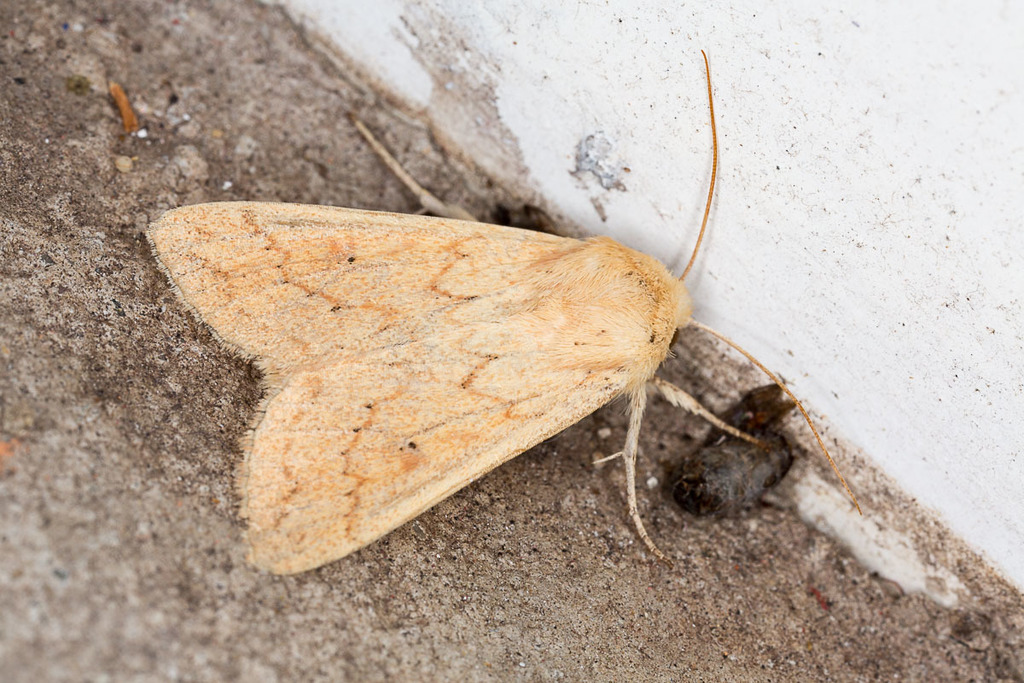
The Delicate has a wingspan of about 36 to 43 mm and forewings 12 to 14 mm long, with pale yellow-ochre wings flushed with rufous and faint markings. Adults fly in August and October in the British Isles, though they may appear earlier or at different times elsewhere.
Source: Wikipedia
How to recognize it
Forewings are pale yellow-ochre, often strongly flushed with rufous; veins are finely rufous and the lines are fine and somewhat angled. Stigmata are indistinct, the orbicular spot is slight or missing, and the reniform spot is rufous with a dark spot at its lower end; hindwings are ochreous-white, greyer in females, with often fuscous veins.
Source: Wikipedia
Size
Wingspan ranges from 36 to 43 mm. Forewing length is between 12 and 14 mm.
Source: Wikipedia
Where it lives
Less common further north in Europe.
Source: Wikipedia
What it eats
Larvae feed on a variety of grasses.
Source: Wikipedia
Life cycle
Adults are recorded on the wing in August and October, sometimes earlier. The flight season noted refers to the British Isles and may differ elsewhere.
Source: Wikipedia
When you see it
Flight season is August and October, with occasional earlier appearances. Seasonal timing is specific to the British Isles and can vary in other regions.
Source: Wikipedia
Where it comes from
Also occurs in North Africa, the Near East, the Middle East, Central Asia and western China.
Source: Wikipedia
Questions people ask
When can I see adult Delicate moths?
In the British Isles they are usually seen in August and October, though they may appear earlier or at different times elsewhere.
Source: Wikipedia
Same family (Noctuidae)
 Ipsilon Dart MothAgrotis ipsilonDamages trees, gardens or crops
 Fall Armyworm MothSpodoptera frugiperdaDamages trees, gardens or crops
 Army Cutworm MothEuxoa auxiliarisDamages trees, gardens or crops
 Large Yellow UnderwingNoctua pronubaDamages trees, gardens or crops
 Silver ΥAutographa gamma
 American DaggerAcronicta americanaCan irritate skin
Sources
- Wikipedia: https://en.wikipedia.org/wiki/Mythimna_vitellina
Look it up elsewhere: GBIF · iNaturalist · BugGuide · Wikipedia
Text written 2026-10-22 from the sources above and checked sentence by sentence against them. Data fetched 2026-10-22.