 Bug FAQ
Texas Turtle Ant
Cephalotes texanus · Order: Hymenoptera · Family: Formicidae
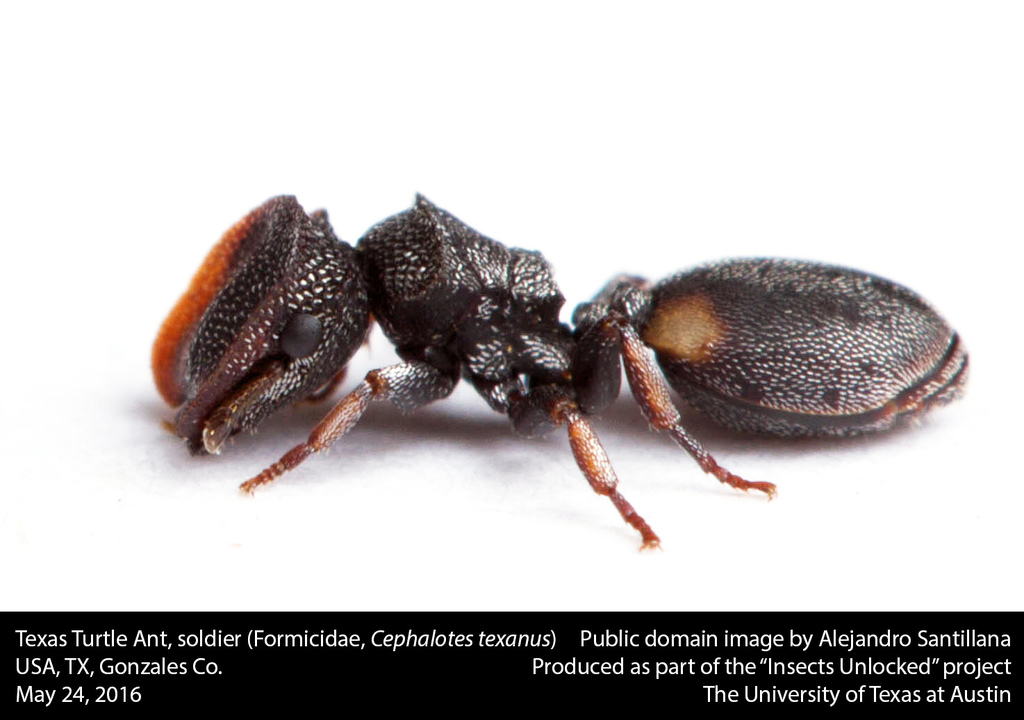
Texanus-group turtle ants have a distinctive odd-shaped head. Their large, flat legs let them glide through the air. They live in the nests of longhorn beetle larvae and are native to Texas and parts of northeastern Mexico.
Source: Wikipedia
How to recognize it
They are recognized by an oddly shaped head. Their unusually large, flat legs give them the ability to glide.
Source: Wikipedia
Where it lives
They nest inside the galleries created by longhorn beetle larvae.
Source: Wikipedia
Where it comes from
They are native to Texas and the Mexican states of Nuevo León, San Luis Potosí, and Tamaulipas.
Source: Wikipedia
Where it is found in the US
Recorded in 1 of 51 states and DC. Most records: Texas.
Darker = more records. Counts are museum and citizen-science records, not population size.
Source: GBIF
Months it is reported in the US
Source: GBIF
More photos

Questions people ask
Where are Texanus-group turtle ants found?
They occur in Texas and in the Mexican states of Nuevo León, San Luis Potosí, and Tamaulipas.
Source: Wikipedia
How can I tell these ants apart from similar species?
Look for the odd-shaped head and the large, flat legs that enable gliding.
Source: Wikipedia
Same family (Formicidae)
 Eastern Black Carpenter AntCamponotus pennsylvanicusCan bite
 Red Imported Fire AntSolenopsis invictaCan sting
 American Winter AntPrenolepis imparis
 Argentine AntLinepithema humileNuisance, not dangerous
 Immigrant Pavement AntTetramorium immigransCan sting
 Odorous House AntTapinoma sessileCan damage your home
Sources
- Wikipedia: https://en.wikipedia.org/wiki/Cephalotes_texanus
Look it up elsewhere: GBIF · iNaturalist · BugGuide · ITIS · Wikipedia
Text written 2026-10-27 from the sources above and checked sentence by sentence against them. Data fetched 2026-10-27.