 Bug FAQ
Tawny Crazy Ant
Nylanderia fulva · Order: Hymenoptera · Family: Formicidae
Source: Wikipedia

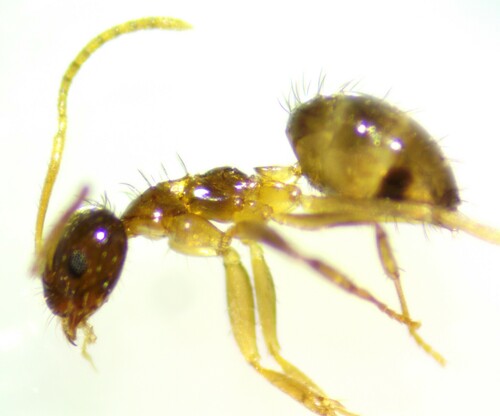
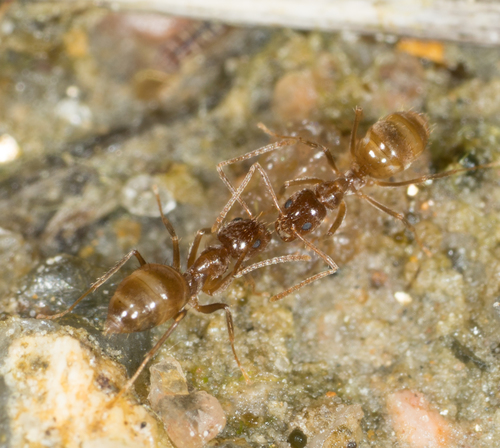
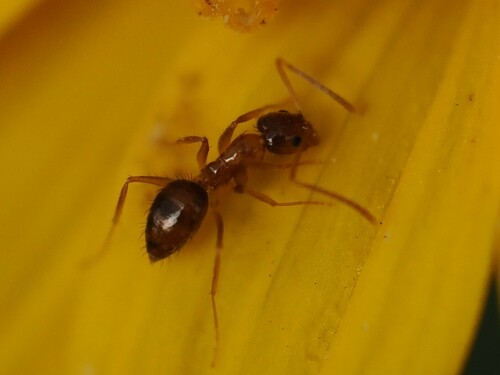
Tawny crazy ants are small, about 3 mm long, and covered in reddish-brown hairs. They live in many colonies without a central nest, have multiple queens, and are hard to control with standard baits or over-the-counter pesticides. They feed on liquids like nectar and honeydew, tend aphids, and can cause short circuits by chewing insulation.
Source: Wikipedia
How to recognize it
Workers are covered with reddish-brown hairs. Their larvae are plump, hairy, and have distinctive mouthparts and mandibles for identification.
Source: Wikipedia
Size
Adults are about 3 mm (1/8 inch) long, smaller than red imported fire ants.
Source: Wikipedia
Is it a pest in the house?
They have displaced other ant species, including red imported fire ants, in both their native range and the U.S. Infestations in electrical equipment can cause short circuits by chewing insulation and wiring.
Source: Wikipedia
Does it bite or sting?
When disturbed they bite and spray formic acid from an acidopore, causing a brief, mild pain. They also use formic acid to neutralize fire-ant venom alkaloids.
Source: Wikipedia
How to get rid of it
Standard ant baits and over-the-counter pesticides are ineffective because of their multiple-queen colonies. In 2008 the EPA gave temporary approval for fipronil use in infested counties, but its application remains restricted.
Source: Wikipedia
Where it lives
Colonies nest under stones or debris and do not build a single mound or central nest.
Source: Wikipedia
What it eats
They consume liquids such as plant nectar and insect honeydew. They also tend aphids for honeydew, eat small insects and vertebrates, and seek sweet plant material.
Source: Wikipedia
Life cycle
Colonies contain multiple queens, which helps them survive and spread.
Source: Wikipedia
When you see it
By 2012 they had colonies in every Gulf Coast state, but by 2021 their range was limited to some southern U.S. areas.
Source: Wikipedia
Where it comes from
The species originates from South America and is a pest in Colombia and other parts of the continent.
Source: Wikipedia
Lookalikes
In Texas they are called “Rasberry crazy ant” after exterminator Tom Rasberry who noted their rise in 2002. Large outbreaks on St Croix were sometimes misidentified as the related hairy crazy ant, Nylanderia pubens.
Source: Wikipedia
Where it is found in the US
Recorded in 6 of 51 states and DC. Most records: Mississippi, Texas, Florida, Georgia, Alabama, Louisiana.
Darker = more records. Counts are museum and citizen-science records, not population size.
Source: GBIF
Status: introduced in United States. Source: iNaturalist
Months it is reported in the US
Source: GBIF
More photos

Questions people ask
Do tawny crazy ants bite?
Yes, they bite and spray formic acid, which causes a short, mild pain.
Source: Wikipedia
Can they damage my home?
They can chew through insulation and wiring, leading to short circuits in electrical devices.
Source: Wikipedia
Why don’t regular ant baits work?
Their colonies have many queens and they are not attracted to ordinary ant baits, making standard products ineffective.
Source: Wikipedia
Where are these ants from?
They are native to South America and have become pests in Colombia and other parts of the continent.
Source: Wikipedia
Same family (Formicidae)
 Eastern Black Carpenter AntCamponotus pennsylvanicusCan damage your home
 Red Imported Fire AntSolenopsis invictaCan sting
 American Winter AntPrenolepis imparis
 Argentine AntLinepithema humileNuisance, not dangerous
 Immigrant Pavement AntTetramorium immigransCan sting
 Odorous House AntTapinoma sessileCan damage your home
Sources
- Wikipedia: https://en.wikipedia.org/wiki/Rasberry_crazy_ant
Look it up elsewhere: GBIF · iNaturalist · BugGuide · Wikipedia
Text written 2026-10-22 from the sources above and checked sentence by sentence against them. Data fetched 2026-10-22.