 Bug FAQ
Asian Red-tailed Spider Wasp
Tachypompilus analis · Order: Hymenoptera · Family: Pompilidae
Also called: Spider wasp
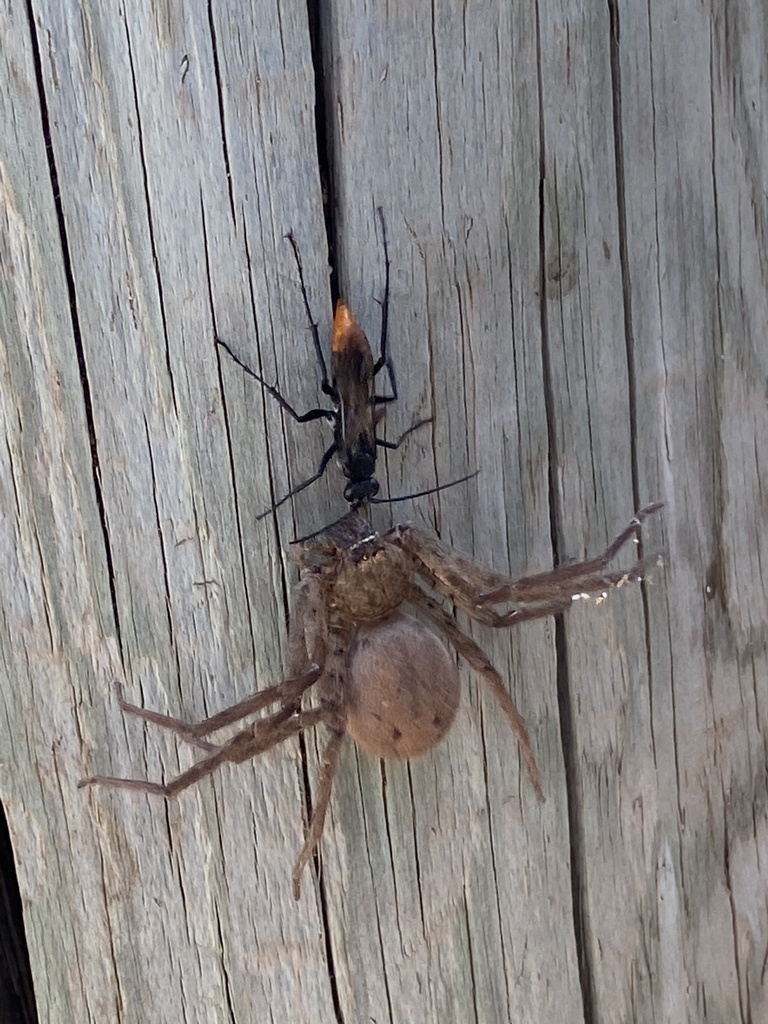
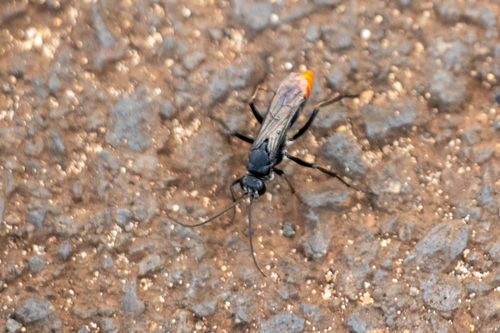
The Asian red-tailed spider wasp is a medium-large wasp, females 16 to 21 mm and males about 11 mm long. It is almost all black except for the last four (female) or five (male) abdominal segments, which are bright orange or red.
Source: Wikipedia
How to recognize it
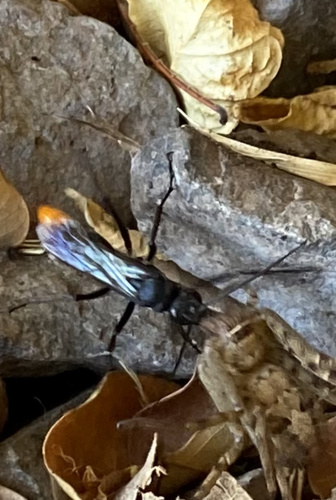
The wasp’s abdomen ends in bright orange or red segments to four in females, five in males to giving it the name red-tailed spider wasp.
Source: Wikipedia
Size
Females measure 16 to 21 mm, while males are about 11 mm long.
Source: Wikipedia
Where it lives
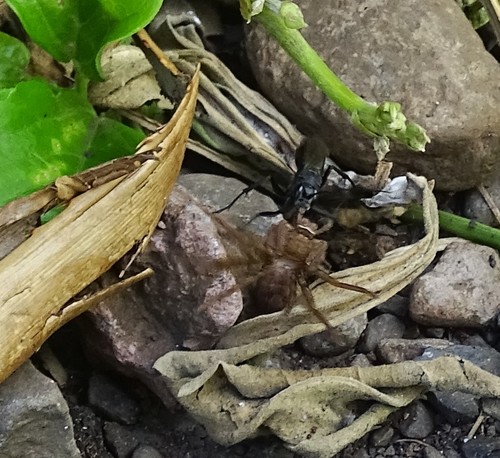
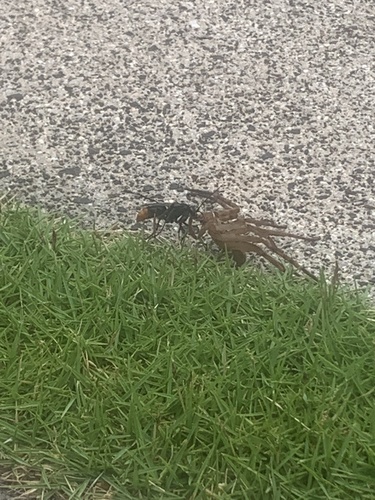
These wasps commonly hunt huntsman spiders.
Source: Wikipedia
What it eats
They prey on spiders of the families Sparassidae, Agelenidae and Amaurobiidae. The wasp can enter complex webs, flush the spider, and continue attacking until the spider drops to the ground where it is stung and paralysed.
Source: Wikipedia
Life cycle
Males often patrol nesting areas to mate with newly emerged females. After laying eggs, the wasp covers the nest with soil, or may use existing cavities.
Source: Wikipedia
Where it comes from
They are found throughout tropical and subtropical Asia, extending north to Japan.
Source: Wikipedia
Lookalikes
The kleptoparasitic wasp Irenangelus luzonensis, and other Irenangelus species, are recorded stealing prey from T. analis.
Source: Wikipedia
Where it is found in the US
Recorded in 1 of 51 states and DC. Most records: Hawaii.
Darker = more records. Counts are museum and citizen-science records, not population size.
Source: GBIF
Months it is reported in the US
Source: GBIF
More photos
Questions people ask
Where can I find this wasp?
It occurs across most tropical and subtropical Asia, reaching as far north as Japan.
Source: Wikipedia
What does the red tail refer to?
The last four (female) or five (male) abdominal segments are bright orange or red, giving the wasp its name.
Source: Wikipedia
Same family (Pompilidae)

Sources
- Wikipedia: https://en.wikipedia.org/wiki/Tachypompilus_analis
Look it up elsewhere: GBIF · iNaturalist · BugGuide · Wikipedia
Text written 2026-10-23 from the sources above and checked sentence by sentence against them. Data fetched 2026-10-23.