 Bug FAQ
Tamarack Looper
Eupithecia misturata · Order: Lepidoptera · Family: Geometridae
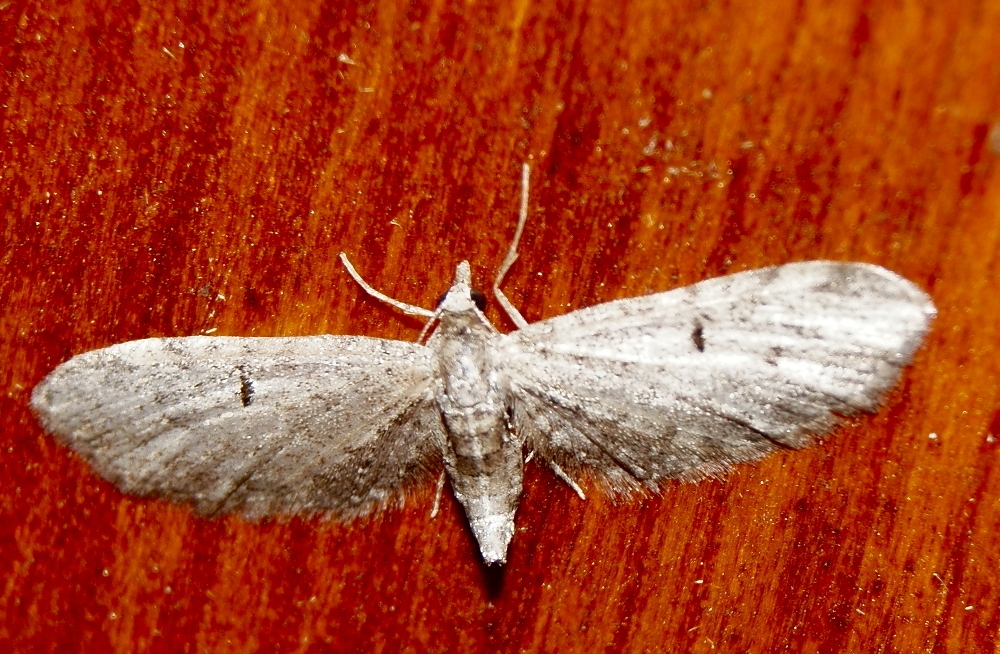
The Tamarack Looper moth has a wingspan of about 16 to 18 millimetres. It lives across western North America and visits flowering trees and shrubs such as Holodiscus, Ceanothus, Arctostaphylos and oak.
Source: Wikipedia
Size
The adult’s wingspan measures roughly 16 to 18 mm.
Source: Wikipedia
What it eats
Adults feed on the flowers of trees and shrubs such as Holodiscus, Ceanothus, Arctostaphylos and oak.
Source: Wikipedia
Where it comes from
The species is widely distributed in western North America.
Source: Wikipedia
Where it is found in the US
Recorded in 20 of 51 states and DC. Most records: California, Colorado, Washington, Oregon, Utah, Montana, New Mexico, New York.
Darker = more records. Counts are museum and citizen-science records, not population size.
Source: GBIF
Status: native in North America; native in Canada; native in United States. Source: iNaturalist
Months it is reported in the US
Source: GBIF
Questions people ask
What plants does the Tamarack Looper feed on?
It feeds on the flowers of several shrubs and trees, including Holodiscus discolor, Ceanothus velutinus, Arctostaphylos and oak species.
Source: Wikipedia
Where is the Tamarack Looper found?
It is widely distributed across western North America.
Source: Wikipedia
Same family (Geometridae)




Sources
- Wikipedia: https://en.wikipedia.org/wiki/Eupithecia_misturata
Look it up elsewhere: GBIF · iNaturalist · BugGuide · ITIS · Wikipedia
Text written 2026-10-25 from the sources above and checked sentence by sentence against them. Data fetched 2026-10-25.