 Bug FAQ
Talitropsis sedilloti
Talitropsis sedilloti · Order: Orthoptera · Family: Rhaphidophoridae

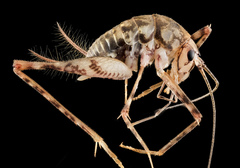
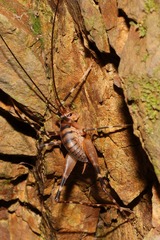
Talitropsis sedilloti is a shiny pale orange-brown cave wētā about 14 mm long in females and up to 18 mm in males. It lives in New Zealand rain-forest habitats, hiding in hollow tree branches by day and foraging at night on fungi, algae, lichens and dead insects.
Source: Wikipedia
How to recognize it
Adults have a glossy pale orange-brown colour and their hind tibiae bear two rows of prominent spines along most of their length.
Source: Wikipedia
Size
Females are about 14 mm long, while males can reach up to 18 mm.
Source: Wikipedia
Where it lives
They are found in rainforest areas, sheltering during daylight in hollow tree branches.
Source: Wikipedia
What it eats
It feeds on fungi, algae and lichens that grow on trees and rocks. It also scavenges dead insects when protein is needed.
Source: Wikipedia
Life cycle
The life cycle usually takes about two years to complete. Egg-laying peaks between April and June, with hatching most common in December and January.
Source: Wikipedia
When you see it
Adults are most often seen foraging at night in December and January. Mating activity has been observed in April.
Source: Wikipedia
Where it comes from
This species is endemic to Aotearoa New Zealand.
Source: Wikipedia
Lookalikes
The prominent spines on the hind tibiae help tell it apart from other tokoriro species, which have much finer spines.
Source: Wikipedia
More photos

Questions people ask
When are Talitropsis sedilloti most active?
Adults are most active at night during December and January.
Source: Wikipedia
Where does this wētā live?
It lives in New Zealand rain-forest habitats, hiding in hollow tree branches by day and in leaf litter or on tree trunks at night.
Source: Wikipedia
What does Talitropsis sedilloti eat?
It eats fungi, algae and lichens on trees and rocks, and will scavenge dead insects for protein.
Source: Wikipedia
Same family (Rhaphidophoridae)




Sources
- Wikipedia: https://en.wikipedia.org/wiki/Talitropsis_sedilloti
Look it up elsewhere: GBIF · iNaturalist · BugGuide · Wikipedia
Text written 2026-10-23 from the sources above and checked sentence by sentence against them. Data fetched 2026-10-23.