 Bug FAQ
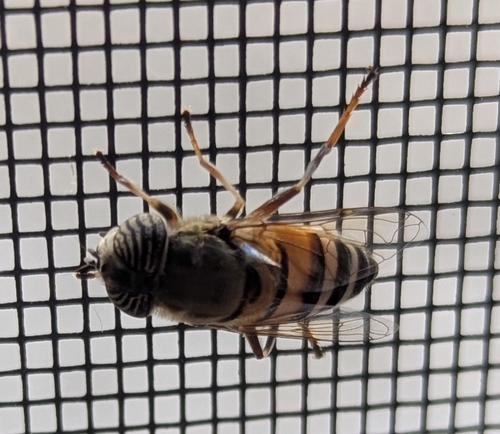
Stripe-eyed Lagoon Fly
Eristalinus taeniops · Order: Diptera · Family: Syrphidae
Also called: Band-eyed Drone Fly, Syrphid fly
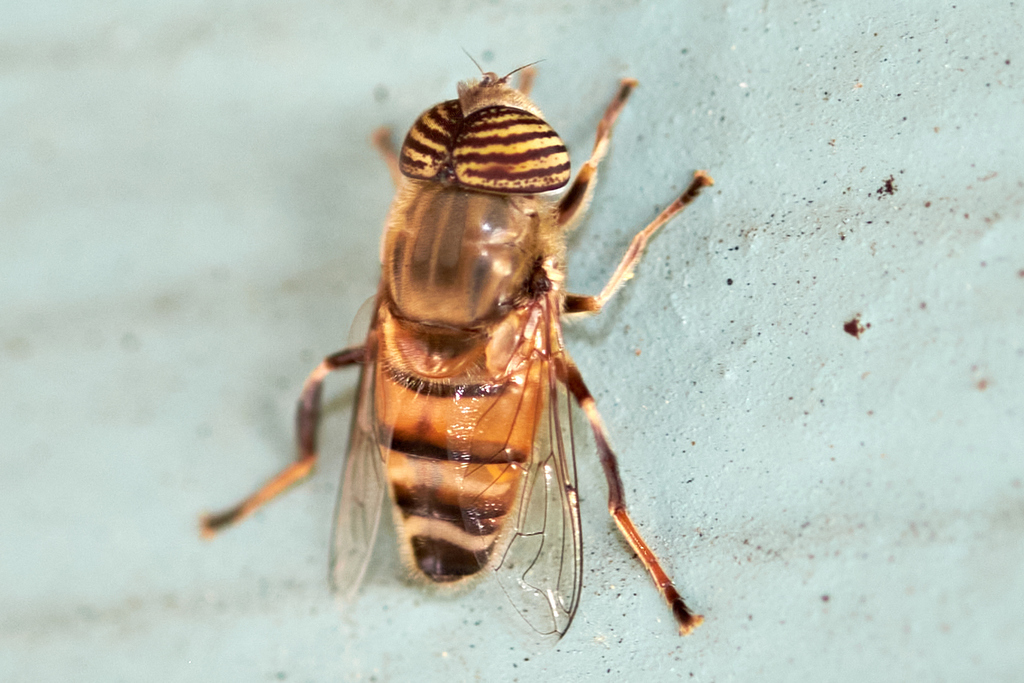
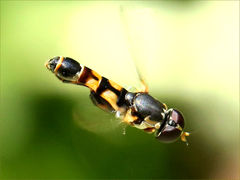
The stripe-eyed lagoon fly is a small hoverfly about 11 to 14 mm long with striking striped eyes and yellow-black markings that make it look like a bee or wasp. It lives in a wide range of wet habitats such as forest clearings, rivers, streams, coastal marshes and holly oak forests across Europe, North Africa, the Near East and parts of Asia. Adults are active from April through October, most common between May and August, feeding on nectar from yellow and white flowers.
Source: Wikipedia
How to recognize it
Its body is patterned in yellow and black, a classic case of Batesian mimicry that often leads people to mistake it for a bee or wasp. The compound eyes have five vertical dark stripes, giving the species its common name.
Source: Wikipedia
Size
Adults measure between 11 and 14 mm in length.
Source: Wikipedia
Where it lives
You can find them in holly oak forests, forest clearings, maquis, alongside rivers and streams, and in coastal marshes.
Source: Wikipedia
What it eats
Adults sip nectar from yellow and white flowers like Erica, Daphne, Senecio and members of the rose family. The larvae are rat-tailed maggots that develop in mud, animal carcasses or water polluted with pig manure.
Source: Wikipedia
Life cycle
Adults are present from April to October, with numbers peaking between May and August.
Source: Wikipedia
When you see it
The flight period runs from early spring to mid-autumn, most abundant in summer months.
Source: Wikipedia
Where it comes from
Their distribution includes many European countries, North Africa, the Near East, the Caucasus, parts of sub-Saharan Africa, and parts of South-Asia such as Nepal, northern India, northern Pakistan and Iran.
Source: Wikipedia
Lookalikes
Because of its bee-like coloration, it is frequently confused with wasps or bees.
Source: Wikipedia
Where it is found in the US
Recorded in 5 of 51 states and DC. Most records: California, Florida, Nevada, Arizona, South Carolina.
Darker = more records. Counts are museum and citizen-science records, not population size.
Source: GBIF
Status: introduced in North America; introduced in United States. Source: iNaturalist
Months it is reported in the US
Source: GBIF
More photos
Questions people ask
Are they harmful to gardens or crops?
They feed on flower nectar and their larvae live in decaying organic matter, not on living plants, so they are not a garden pest.
Source: Wikipedia
Same family (Syrphidae)


Sources
- Wikipedia: https://en.wikipedia.org/wiki/Eristalinus_taeniops
Look it up elsewhere: GBIF · iNaturalist · BugGuide · ITIS · Wikipedia
Text written 2026-10-22 from the sources above and checked sentence by sentence against them. Data fetched 2026-10-22.