 Bug FAQ
Stripe-backed Brusheye
Dasysyrphus albostriatus · Order: Diptera · Family: Syrphidae
Also called: Stripe-backed Fleckwing
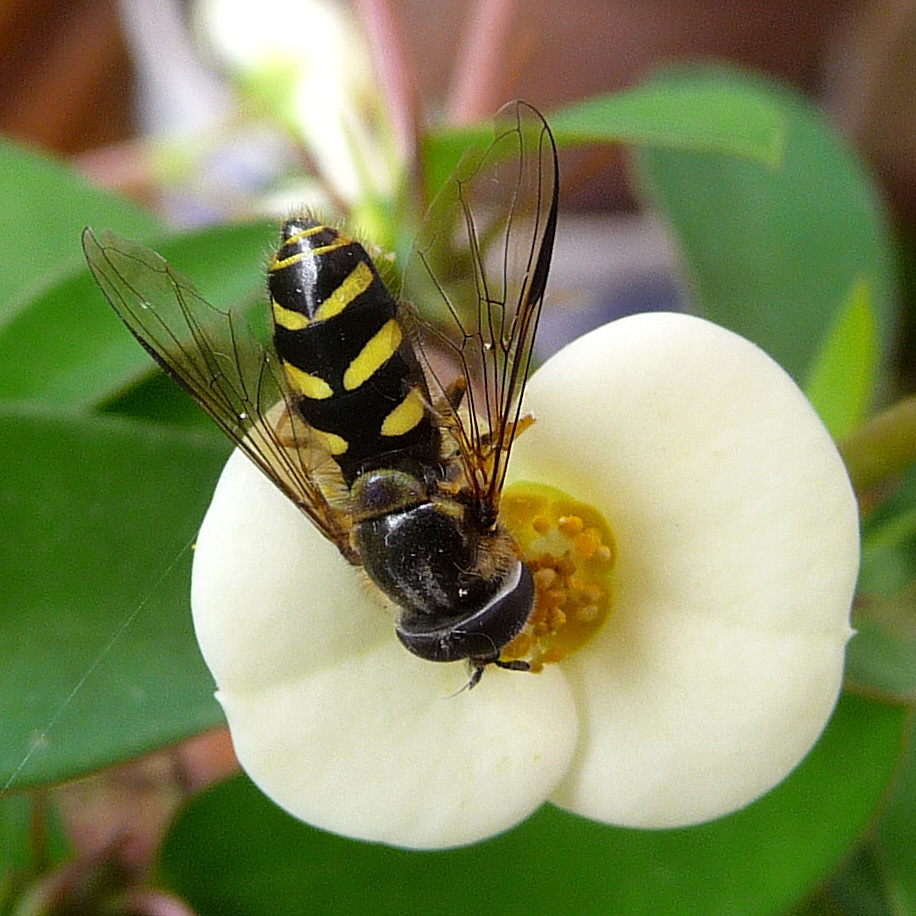
Dasysyrphus albostriatus is a hoverfly with wing length between about 6.3 and 9.5 mm. Its thorax is shiny black with two white dust-filled stripes, and its abdomen shows linear yellow spots that may join on segments three and four. Adults fly from early April in southern Europe through September, living in woodlands, parks, gardens and even alpine zones.
Source: Wikipedia
How to recognize it
The back of the thorax has two central white dust-filled stripes, and the abdomen bears linear yellow spots that sometimes connect on the third and fourth segments.
Source: Wikipedia
Size
Wing length ranges from 6.25 mm to 9.5 mm.
Source: Wikipedia
Where it lives
Found in coniferous and deciduous woodlands, plantations, clearings, parks, gardens and even up to the alpine zone.
Source: Wikipedia
What it eats
Larvae mainly eat aphids but also prey on many soft-bodied insects.
Source: Wikipedia
Life cycle
Adults are on the wing from the end of April (earlier in southern Europe) through September.
Source: Wikipedia
When you see it
Flight period spans late April to September, starting earlier in southern Europe.
Source: Wikipedia
Where it comes from
Native to the Palaearctic region, from Fennoscandia south to Iberia and North Africa, across Europe into Central Asia and Japan.
Source: Wikipedia
Lookalikes
It is a Palearctic hoverfly species.
Source: Wikipedia
Same family (Syrphidae)






Sources
- Wikipedia: https://en.wikipedia.org/wiki/Dasysyrphus_albostriatus
Look it up elsewhere: GBIF · iNaturalist · BugGuide · Wikipedia
Text written 2026-10-23 from the sources above and checked sentence by sentence against them. Data fetched 2026-10-22.