 Bug FAQ
Square-spot Rustic
Xestia xanthographa · Order: Lepidoptera · Family: Noctuidae
Also called: Square-spot rustic moth

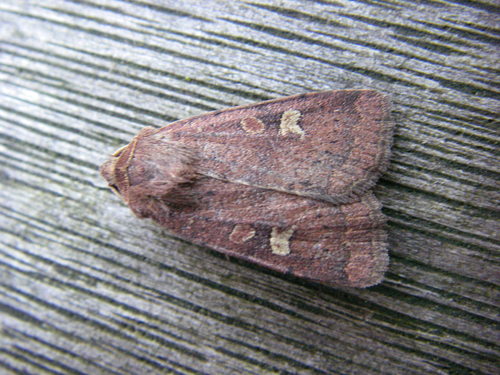
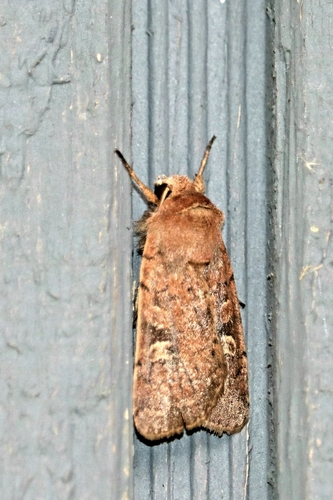
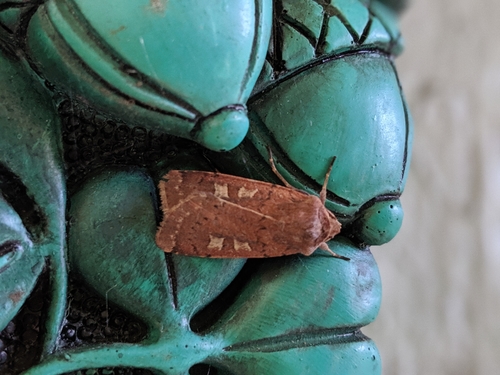
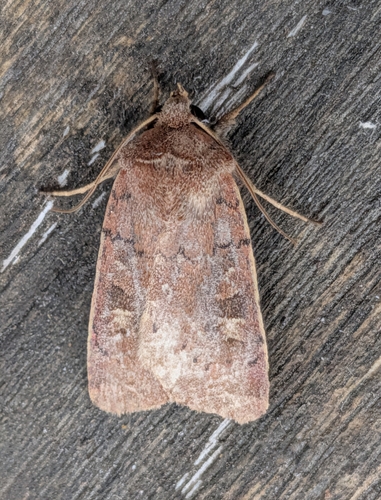
The square-spot rustic has a wingspan of about 3 to 4 cm and is most easily recognised by a large pale square spot on its forewings. It lives on woodland edges, waste ground and suburban areas across most of England and the wider Palearctic region.
Source: Wikipedia
How to recognize it
The most distinctive mark is a large pale square stigma on the forewing. The hindwings are a shade of grey with a whitish fringe.
Source: Wikipedia
Size
Its wingspan ranges from 30 to 40 mm.
Source: Wikipedia
Where it lives
It is found on woodland edges, waste ground and in suburban habitats.
Source: Wikipedia
What it eats
Adults also visit flowers like heather, marram grass and ragwort.
Source: Wikipedia
Life cycle
The species overwinters as a larva and continues feeding throughout the winter.
Source: Wikipedia
When you see it
Adults are active at night from July through September.
Source: Wikipedia
Where it comes from
Its native range includes Europe, North Africa, the Palearctic (except China) and North America.
Source: Wikipedia
Lookalikes
Similar forms include ab. budensis with a grey ground colour, ab. elutior with brighter cinnamon-brown or yellowish-grey forewings, and ab. palaestinensis with paler ground colour and clearer markings.
Source: Wikipedia
Where it is found in the US
Recorded in 5 of 51 states and DC. Most records: Oregon, Washington, Massachusetts, Idaho, California.
Darker = more records. Counts are museum and citizen-science records, not population size.
Source: GBIF
Status: introduced in Canada; introduced in United States. Source: iNaturalist
Months it is reported in the US
Source: GBIF
More photos
Questions people ask
Are they a problem for gardens or crops?
They feed on a range of plants, but the sources do not say they cause damage.
Source: Wikipedia
How can I tell this moth apart from similar species?
Look for the large pale square spot on the forewing and the grey hindwing with a whitish fringe.
Source: Wikipedia
Same family (Noctuidae)
 Ipsilon Dart MothAgrotis ipsilonDamages trees, gardens or crops
 Fall Armyworm MothSpodoptera frugiperdaDamages trees, gardens or crops
 Army Cutworm MothEuxoa auxiliarisDamages trees, gardens or crops
 Large Yellow UnderwingNoctua pronubaDamages trees, gardens or crops
 Silver ΥAutographa gamma
 American DaggerAcronicta americanaCan irritate skin
Sources
- Wikipedia: https://en.wikipedia.org/wiki/Square-spot_rustic
Look it up elsewhere: GBIF · iNaturalist · BugGuide · ITIS · Wikipedia
Text written 2026-10-22 from the sources above and checked sentence by sentence against them. Data fetched 2026-10-22.