 Bug FAQ
Spotted Camel Cricket
Ceuthophilus maculatus · Order: Orthoptera · Family: Rhaphidophoridae
Source: yardandgarden.extension.iastate.edu, University of Minnesota Extension
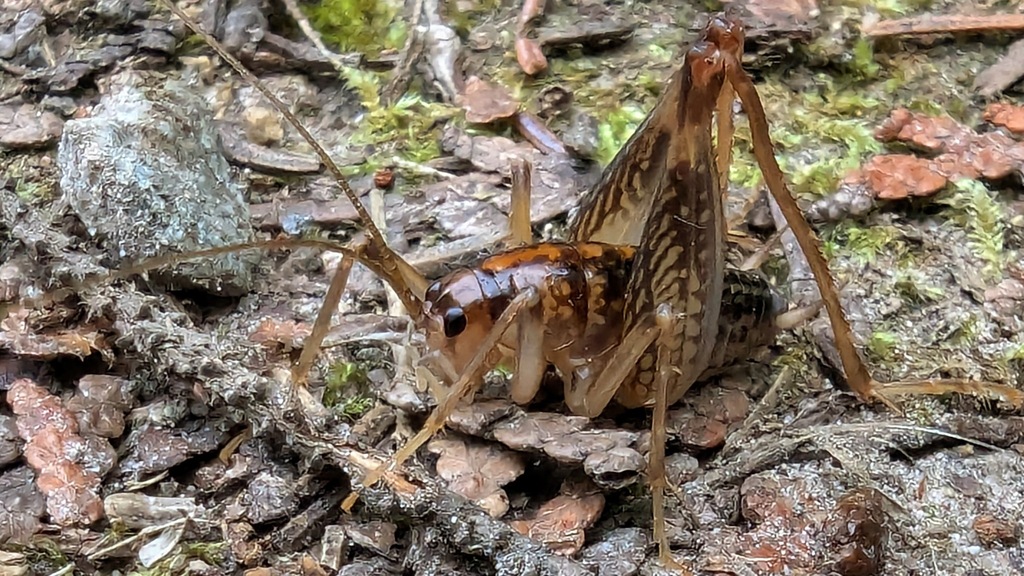
It lives at night in dark, moist places such as under rocks, logs, bark, or in basements and crawlspaces, and it eats fungi, roots, foliage, fruit and other insects. In homes it may feed on cotton, linen, silk or wool, and it is considered a nuisance pest, especially in basements.
Source: Wikipedia, yardandgarden.extension.iastate.edu, University of Minnesota Extension, extension.umaine.edu
How to recognize it
Its body is glossy dark brown with yellow-brown to reddish-brown spots on the thorax and hind legs. Camel crickets are brownish, hump-backed, wingless and up to about one inch long.
Source: Wikipedia, yardandgarden.extension.iastate.edu, University of Minnesota Extension
Size
Adults measure 10 to 19 mm (about 0.4 to 0.75 in) in length.
Source: Wikipedia
Is it a pest in the house?
Camel crickets are of little economic importance but can be a nuisance in homes, especially basements. They can feed on fabrics such as cotton, linen, silk and wool. They are attracted to cool, dark, moist areas and often wander indoors from nearby habitats.
Source: yardandgarden.extension.iastate.edu, University of Minnesota Extension, extension.umaine.edu
How to get rid of it
Reduce outdoor breeding and hiding sites around the building as a first step. Eliminate indoor dark, moist areas such as basements, crawlspaces and storage rooms where they hide. If needed, treat exterior areas with an insecticide labeled for home use, such as permethrin, β-cyfluthrin or deltamethrin. Indoor floor treatments are a last resort and offer limited benefit.
Source: University of Minnesota Extension, yardandgarden.extension.iastate.edu, extension.umaine.edu
Where it lives
They are nocturnal and hide in dark, moist locations under rocks, soil, logs, bark, or inside basements, crawlspaces and garages.
Source: Wikipedia, extension.umaine.edu
What it eats
It is omnivorous, feeding on fungi, plant roots, foliage, fruit and other insects.
Source: Wikipedia
Where it comes from
This species is found in North America.
Source: Wikipedia
Lookalikes
Common house crickets include field crickets, camel crickets and house crickets; field crickets are known for their song. All crickets have large hind legs and long antennae.
Source: University of Minnesota Extension, yardandgarden.extension.iastate.edu
Where it is found in the US
Recorded in 16 of 51 states and DC. Most records: Illinois, Connecticut, Vermont, Minnesota, Massachusetts, New York, Indiana, Maine.
Darker = more records. Counts are museum and citizen-science records, not population size.
Source: GBIF
Months it is reported in the US
Source: GBIF
Questions people ask
How can I keep camel crickets out of my house?
Seal entry points, remove outdoor debris, and reduce indoor moisture and clutter where they could hide; use an exterior insecticide if necessary.
Source: University of Minnesota Extension, extension.umaine.edu
Do camel crickets damage anything in the home?
Yes, they can chew on fabrics such as cotton, linen, silk and wool.
What do camel crickets look like?
They are wingless, hump-backed crickets about 10 to 19 mm long, dark brown with yellow-brown spots, and have antennae as long as or longer than their bodies.
Where are camel crickets commonly found?
They live in North America, preferring dark, moist places like under rocks, logs, bark, and inside basements or crawlspaces.
Source: Wikipedia, extension.umaine.edu
Same family (Rhaphidophoridae)



Sources
- yardandgarden.extension.iastate.edu: https://yardandgarden.extension.iastate.edu/encyclopedia/camel-cricket
- University of Minnesota Extension: https://extension.umn.edu/nuisance-insects/crickets
- Wikipedia: https://en.wikipedia.org/wiki/Ceuthophilus_maculatus
- extension.umaine.edu: https://extension.umaine.edu/home-and-garden-ipm/common-name-listing/camel-cricket/
Look it up elsewhere: GBIF · iNaturalist · BugGuide · ITIS · Wikipedia
Text written 2026-10-23 from the sources above and checked sentence by sentence against them. Data fetched 2026-10-23.