 Bug FAQ
Southern Pill Woodlouse
Armadillidium depressum · Order: Isopoda · Family: Armadillidiidae

The Southern Pill Woodlouse can grow up to about 20 mm long, a bit larger than the common woodlouse.
Source: Wikipedia
How to recognize it
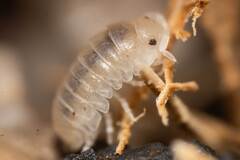
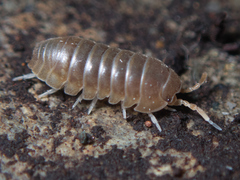
When it rolls into a ball, a small gap remains instead of a perfect seal. Its rear body (pleon) curves outward, giving it a splayed look.
Source: Wikipedia
Size
Adults may reach a length of about 20 mm, slightly longer than the 18 mm of the common woodlouse.
Source: Wikipedia
What it eats
It feeds on dead plant matter.
Source: Wikipedia
Life cycle
It can be seen throughout the year.
Source: Wikipedia
When you see it
It is present all year long.
Source: Wikipedia
Where it comes from
Most records are from southwest Britain near the English Channel, with smaller populations scattered across England.
Source: Wikipedia
Lookalikes
It looks very similar to the common woodlouse, dark grey to black, but can be told apart by the gap when rolled up.
Source: Wikipedia
More photos


Questions people ask
How can I tell the Southern Pill Woodlouse apart from the common woodlouse?
Look for a small gap when it rolls into a ball and a outward-curving pleon that gives a splayed appearance.
Source: Wikipedia
Same family (Armadillidiidae)



Sources
- Wikipedia: https://en.wikipedia.org/wiki/Armadillidium_depressum
Look it up elsewhere: GBIF · iNaturalist · BugGuide · ITIS · Wikipedia
Text written 2026-10-23 from the sources above and checked sentence by sentence against them. Data fetched 2026-10-22.