 Bug FAQ
South American Toothed Hacklemesh Weaver
Metaltella simoni · Order: Araneae · Family: Desidae
Also called: Hacklemesh Weaver, Cribellate spider

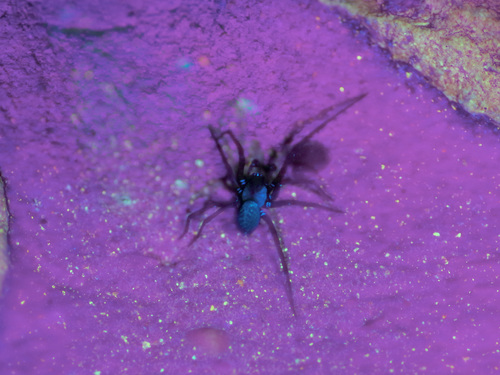
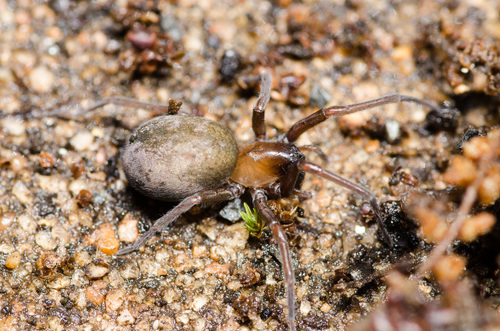
Females measure about 8 to 9 mm and males about 7 to 8.5 mm in length. Both sexes are brown with darker front carapace, leg ends and chelicerae, while the abdomen is mottled grey-black with faint pale chevrons; males show an orange-yellow patch on the rear carapace. They are found under ground-level logs and are common along the coast of southern California.
Source: Wikipedia
How to recognize it
Both sexes are brown with darker areas on the front of the carapace, leg tips and chelicerae; the abdomen is mottled grey-black with faint pale chevrons, and males have an orange-yellow rear-carapace patch that darkens toward the front.
Source: Wikipedia
Size
Females are about 8 to 9 mm long, while males are roughly 7 to 8.5 mm.
Source: Wikipedia
Where it lives
It has been found under logs at ground level. The species is widespread along the coastal region of southern California.
Source: Wikipedia
Where it comes from
The spider is native to South America, specifically Brazil, Uruguay and Argentina.
Source: Wikipedia
Where it is found in the US
Recorded in 15 of 51 states and DC. Most records: California, Texas, Georgia, Florida, Alabama, South Carolina, Louisiana, North Carolina.
Darker = more records. Counts are museum and citizen-science records, not population size.
Source: GBIF
Status: introduced in North America; introduced in Canada; introduced in United States. Source: iNaturalist
Months it is reported in the US
Source: GBIF
More photos

Questions people ask
How big are South American Toothed Hacklemesh Weavers?
Females reach about 8 to 9 mm and males about 7 to 8.5 mm in length.
Source: Wikipedia
What do they look like?
They are brown with darker fronts on the carapace, leg ends and chelicerae; the abdomen is mottled grey-black with faint pale chevrons, and males have an orange-yellow area on the rear carapace.
Source: Wikipedia
Where might I find them in my yard?
They are often found under logs at ground level and are common along the coastal southern California area.
Source: Wikipedia
Where is this species originally from?
It is native to South America, specifically Brazil, Uruguay and Argentina.
Source: Wikipedia
Same family (Desidae)
Sources
- Wikipedia: https://en.wikipedia.org/wiki/Metaltella_simoni
Look it up elsewhere: GBIF · iNaturalist · BugGuide · ITIS · Wikipedia
Text written 2026-10-23 from the sources above and checked sentence by sentence against them. Data fetched 2026-10-23.