 Bug FAQ
Grey House Spider
Badumna longinqua · Order: Araneae · Family: Desidae
Also called: Australian Grey House Spider, Australian House Spider, Gray house spider

The grey house spider is a small, light-grey spider with purplish-brown striped legs and a distinctive eye pattern. It builds a single, undisturbed web where the female stays for life, while males wander in warm months to find mates. It catches a variety of insects, especially flies, and is native to eastern Australia but now occurs in several other countries.
Source: Wikipedia
How to recognize it
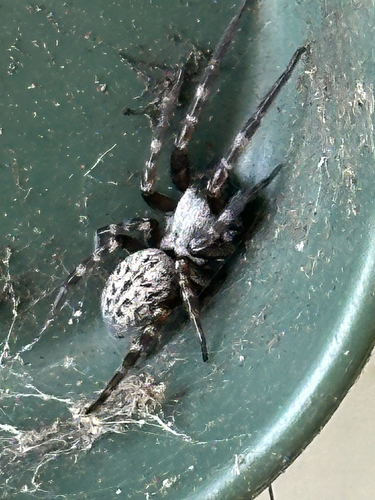
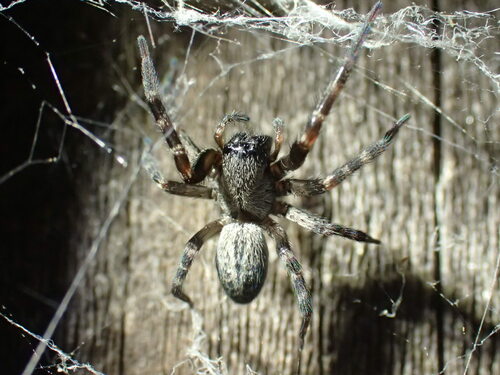
The spider’s body and abdomen are covered in light-grey hairs with spot-like markings, and its legs are purplish-brown with striped hairs.
Source: Wikipedia
Size
Males grow up to about 11 mm (0.43 in) and females up to 15 mm (0.59 in) in body length.
Source: Wikipedia
Is it a pest in the house?
Although common around homes, it is rarely seen because it feeds at night and hides during the day. It does not typically wander into houses in search of a mate.
Source: Wikipedia
Where it lives
It builds its web in calm, undisturbed places, often near homes.
Source: Wikipedia
What it eats
Its diet includes many insects such as psyllids, ants, moths, wasps, bees, bumblebees, cicadas and especially flies, which make up more than half of what it eats.
Source: Wikipedia
Life cycle
Females may remain in the same web for their entire lives, while mature males leave to search for mates. Males start looking for females in the warmer months, from summer through early autumn.
Source: Wikipedia
When you see it
Males are active in searching for mates from summer to early autumn. At night the spider exits its retreat to tend its web and wait for prey, but it does not wander into houses looking for mates.
Source: Wikipedia
Lookalikes
A similar, slightly larger species, Badumna insignis (common black spider), is found only in the northern part of New Zealand’s North Island.
Source: Wikipedia
Where it is found in the US
Recorded in 9 of 51 states and DC. Most records: California, Oregon, Hawaii, Washington, Nevada, Kansas, Michigan, Arizona.
Darker = more records. Counts are museum and citizen-science records, not population size.
Source: GBIF
Status: introduced in North America; introduced in United States; introduced in Canada. Source: iNaturalist
Months it is reported in the US
Source: GBIF
More photos


Questions people ask
Are they a pest in the home?
They are common around houses but stay hidden and do not usually wander inside looking for mates.
Source: Wikipedia
Same family (Desidae)

Sources
- Wikipedia: https://en.wikipedia.org/wiki/Badumna_longinqua
Look it up elsewhere: GBIF · iNaturalist · BugGuide · ITIS · Wikipedia
Text written 2026-10-22 from the sources above and checked sentence by sentence against them. Data fetched 2026-10-22.