 Bug FAQ
Sooty-winged Chalcoela Moth
Chalcoela iphitalis · Order: Lepidoptera · Family: Crambidae
Also called: Sooty-winged Chalcoela

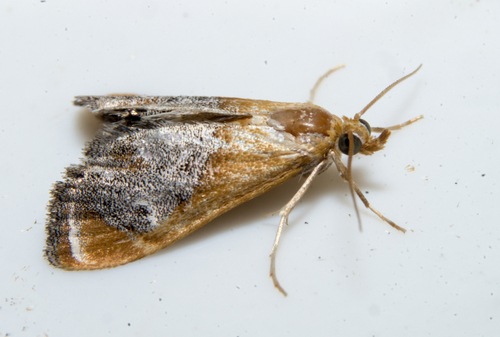
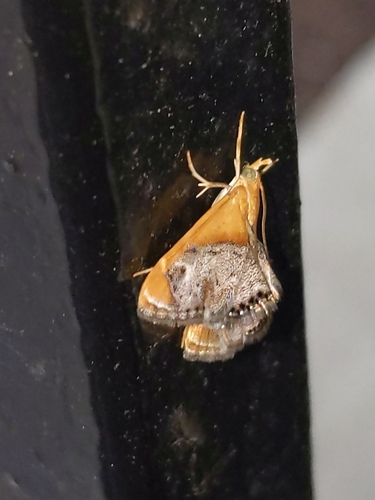
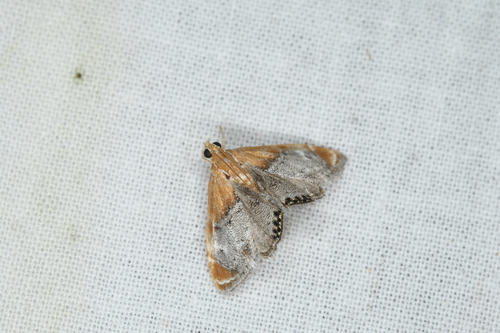
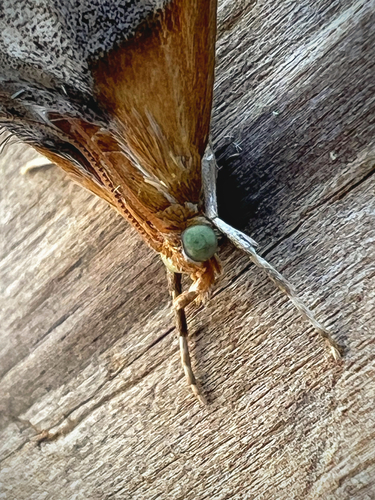
Adults appear from late spring through summer and have a yellow-orange head, body and front wing area with grey-silver hindwings marked by black spots. The species lives across North America, from California and Arizona in the south up to Ontario in the north, and its larvae parasitize paper-wasp larvae.
Source: Wikipedia
Size
Adults can be observed from May through August.
Source: Wikipedia
What it eats
The larvae are parasitoids that feed on the larvae and pupae of paper wasps such as Polistes species and Mischocyttarus flavitarsis. They move among the wasp cells, consuming the developing wasp larvae and pupae.
Source: Wikipedia
Life cycle
After feeding, the larvae spin cocoons in empty cells where they pupate.
Source: Wikipedia
When you see it
Adults are on the wing from May to August.
Source: Wikipedia
Where it comes from
It is a North American species found across the continent.
Source: Wikipedia
Lookalikes
It was originally described under the name Cataclysta iphitalis by Francis Walker in 1859.
Source: Wikipedia
Where it is found in the US
Recorded in 44 of 51 states and DC. Most records: Texas, Colorado, Maryland, Ohio, California, Massachusetts, Oregon, Virginia.
Darker = more records. Counts are museum and citizen-science records, not population size.
Source: GBIF
Status: native in North America; native in Canada; native in United States. Source: iNaturalist
Months it is reported in the US
Source: GBIF
More photos
Questions people ask
When can I see adult sooty-winged chalcoela moths?
Adults are active from May through August.
Source: Wikipedia
What do the larvae of this moth eat?
The larvae parasitize and eat the larvae and pupae of paper wasps, including several Polistes species.
Source: Wikipedia
Where is the sooty-winged chalcoela found?
It occurs across North America, from California, Arizona and South Carolina up to Ontario.
Source: Wikipedia
How can I recognize this moth?
Look for a yellow-orange head, body and front wing area, with grey-silver hindwings that have black spots along the edge.
Source: Wikipedia
Same family (Crambidae)
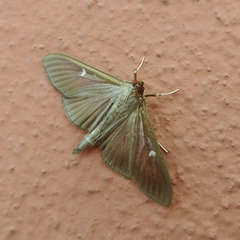 Box Tree MothCydalima perspectalisDamages trees, gardens or crops
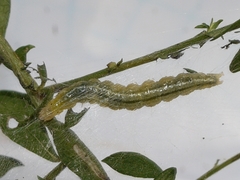 Celery Leaftier MothUdea rubigalisDamages trees, gardens or crops
 Elegant Grass-veneerMicrocrambus elegans
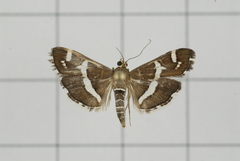 Hawaiian Beet Webworm MothSpoladea recurvalisDamages trees, gardens or crops
 Garden Grass-veneerChrysoteuchia culmellaDamages trees, gardens or crops
 Bluegrass Webworm MothParapediasia teterrellusDamages trees, gardens or crops
Sources
- Wikipedia: https://en.wikipedia.org/wiki/Chalcoela_iphitalis
Look it up elsewhere: GBIF · iNaturalist · BugGuide · Wikipedia
Text written 2026-10-23 from the sources above and checked sentence by sentence against them. Data fetched 2026-10-23.