 Bug FAQ
Garden Grass-veneer
Chrysoteuchia culmella · Order: Lepidoptera · Family: Crambidae
Source: Wikipedia

Garden Grass-veneer is a small moth with a wingspan of about 18 to 24 mm. It flies in early summer, typically from June to July, depending on where you are.
Source: Wikipedia
How to recognize it
The forewings are brown with a whitish streak down the middle that branches toward veins 2-5, often broken by dark scales, and the rear two-thirds may be washed with a pale ochre colour; a row of black dots runs along the edge and the fringe looks metallic. The hindwings are a rather dark grey.
Source: Wikipedia
Size
Wingspan ranges from 18 to 24 mm.
Source: Wikipedia
What it eats
The caterpillars feed on a variety of grass species.
Source: Wikipedia
When you see it
Adults are on the wing from June through July, varying with location.
Source: Wikipedia
Where it comes from
It is found throughout Europe.
Source: Wikipedia
Where it is found in the US
Recorded in 1 of 51 states and DC. Most records: Wyoming.
Darker = more records. Counts are museum and citizen-science records, not population size.
Source: GBIF
More photos

Questions people ask
Will they damage my garden?
Their larvae feed on grasses, so they can cause damage to lawns and garden grass.
Source: Wikipedia
Same family (Crambidae)
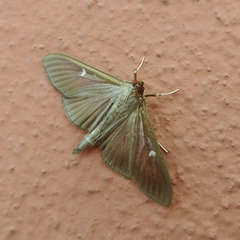 Box Tree MothCydalima perspectalisDamages trees, gardens or crops
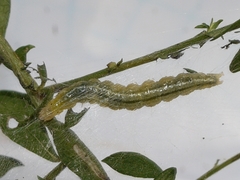 Celery Leaftier MothUdea rubigalisDamages trees, gardens or crops
 Elegant Grass-veneerMicrocrambus elegans
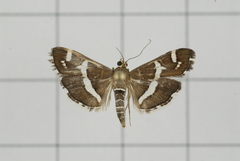 Hawaiian Beet Webworm MothSpoladea recurvalisDamages trees, gardens or crops
 Bluegrass Webworm MothParapediasia teterrellusDamages trees, gardens or crops
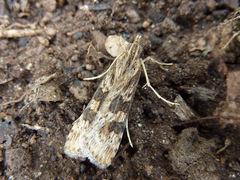 Lucerne MothNomophila nearcticaDamages trees, gardens or crops
Sources
- Wikipedia: https://en.wikipedia.org/wiki/Chrysoteuchia_culmella
Look it up elsewhere: GBIF · iNaturalist · BugGuide · Wikipedia
Text written 2026-10-22 from the sources above and checked sentence by sentence against them. Data fetched 2026-10-22.