 Bug FAQ
Soot sprite
Coptosoma scutellatum · Order: Hemiptera · Family: Plataspidae
Also called: Trapezium Shieldbug
Source: Wikipedia
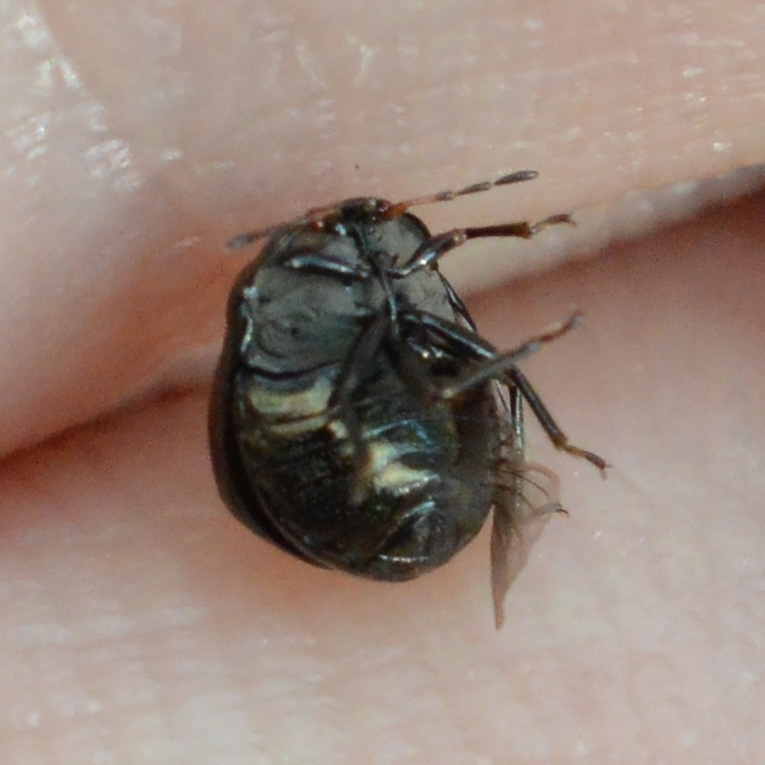
The soot sprite is a tiny true bug about 4 to 5 mm long and almost spherical, shiny black with a green, blue or bronze gloss and yellow edges on the abdomen. Adults appear from summer through September, overwinter as larvae and feed mainly on legumes like alfalfa, birdsfoot trefoil and vetch.
Source: Wikipedia
How to recognize it
They are almost spherical or trapezoidal, deep black and shiny, sometimes showing green, blue or bronze gloss, with yellow edges on the abdomen.
Source: Wikipedia
Size
Adults reach about 4 to 5 mm in length.
Source: Wikipedia
Where it lives
They prefer warm, dry habitats with moderate herbaceous cover, such as lawns, limestone, clay and sandy soils. In the Alps they are common in valleys and can be found up to 1000 m altitude.
Source: Wikipedia
What it eats
They feed on legumes such as alfalfa, birdsfoot trefoil, vetch, lotus, astragalus, sainfoin, broom and restharrows.
Source: Wikipedia
Life cycle
The species overwinters as larvae in the third or fourth instar and becomes adult in May or June. Adults are present from summer until September, with egg-laying in midsummer.
Source: Wikipedia
When you see it
Adults can be observed from summer through September.
Source: Wikipedia
Where it comes from
Their range covers most of southern Europe, North Africa, Siberia, China, Korea and Japan. They are one of four European Coptosoma species; the others are mainly Asian or Ethiopian.
Source: Wikipedia
Lookalikes
It is one of four European Coptosoma species; the others are mostly found in Asia and Ethiopia.
Source: Wikipedia
Questions people ask
What plants do soot sprites feed on?
They mainly eat legumes such as alfalfa, birdsfoot trefoil, vetch and related plants.
Source: Wikipedia
Where are soot sprites commonly found?
They live in warm, dry areas with herbaceous vegetation, like lawns and sandy soils, up to 1000 m in the Alps.
Source: Wikipedia
Are soot sprites a problem for gardens?
Yes, they can damage legume crops and garden plants they feed on.
Source: Wikipedia
Same family (Plataspidae)
Sources
- Wikipedia: https://en.wikipedia.org/wiki/Coptosoma_scutellatum
Look it up elsewhere: GBIF · iNaturalist · BugGuide · Wikipedia
Text written 2026-10-23 from the sources above and checked sentence by sentence against them. Data fetched 2026-10-22.