 Bug FAQ
Solenopsis amblychila
Solenopsis amblychila · Order: Hymenoptera · Family: Formicidae
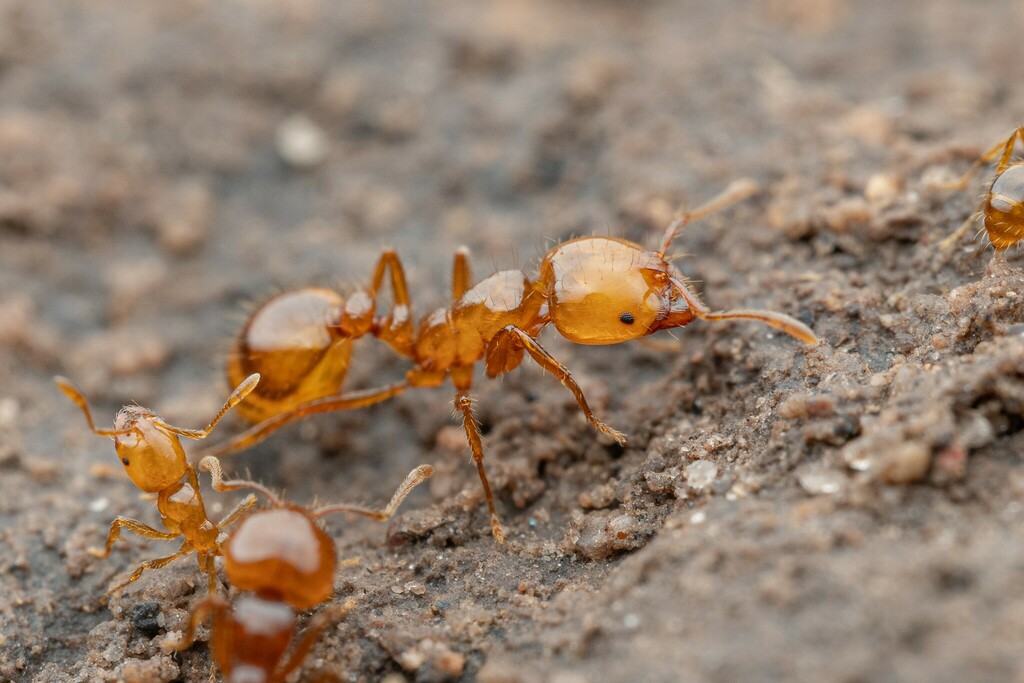
Workers come in two sizes, with both major and minor forms in a colony. They are pale golden or yellow, which often leads to confusion with Solenopsis aurea. They live in the southwestern United States, nesting in soil, under rocks, wood, or in dry lawns.
Source: Wikipedia
How to recognize it
The ants have a pale golden or yellow coloration.
Source: Wikipedia
Size
Colonies contain both larger major workers and smaller minor workers.
Source: Wikipedia
Where it lives
They can survive very dry conditions and are also found in well-watered lawns. Nests are typically in soil, beneath rocks, or under pieces of wood.
Source: Wikipedia
Where it comes from
Solenopsis amblychila is native to the southwestern United States.
Source: Wikipedia
Lookalikes
Because of their golden color they are often mistaken for Solenopsis aurea.
Source: Wikipedia
Where it is found in the US
Recorded in 7 of 51 states and DC. Most records: Arizona, California, Texas, New Mexico, Kansas, Nevada, Oklahoma.
Darker = more records. Counts are museum and citizen-science records, not population size.
Source: GBIF
Status: native in North America; native in United States. Source: iNaturalist
Months it is reported in the US
Source: GBIF
More photos

Questions people ask
How can I tell Solenopsis amblychila apart from similar ants?
Look for the pale golden or yellow body color, which is a key trait of this species.
Source: Wikipedia
Where does Solenopsis amblychila live?
It is native to the southwestern United States and nests in soil, under rocks, or wood, tolerating dry to well-watered lawns.
Source: Wikipedia
Same family (Formicidae)
 Eastern Black Carpenter AntCamponotus pennsylvanicusCan bite
 Red Imported Fire AntSolenopsis invictaCan sting
 American Winter AntPrenolepis imparis
 Argentine AntLinepithema humileNuisance, not dangerous
 Immigrant Pavement AntTetramorium immigransCan sting
 Odorous House AntTapinoma sessileCan damage your home
Sources
- Wikipedia: https://en.wikipedia.org/wiki/Solenopsis_amblychila
Look it up elsewhere: GBIF · iNaturalist · BugGuide · ITIS · Wikipedia
Text written 2026-10-26 from the sources above and checked sentence by sentence against them. Data fetched 2026-10-26.