 Bug FAQ
Small Phoenix
Ecliptopera silaceata · Order: Lepidoptera · Family: Geometridae
Also called: Small Phoenix Moth

The Small Phoenix moth has a wingspan of about 23 to 27 mm and forewings 13 to 17 mm long. It lives in semi-shady parts of deciduous and mixed forests, young plantations and heaths.
Source: Wikipedia
How to recognize it
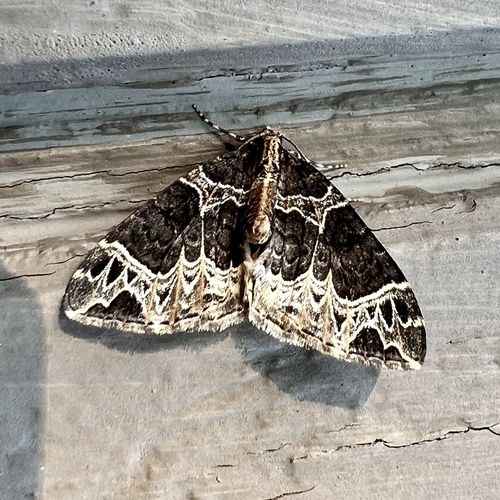
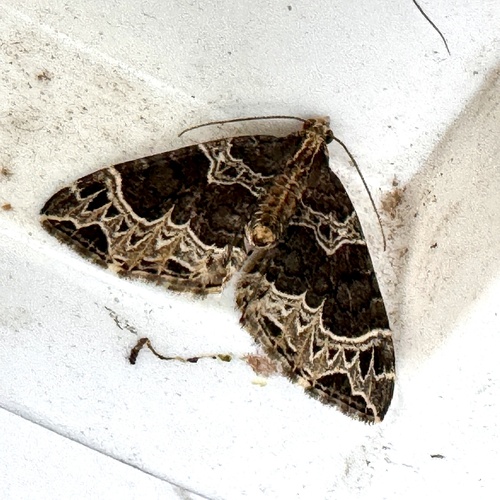
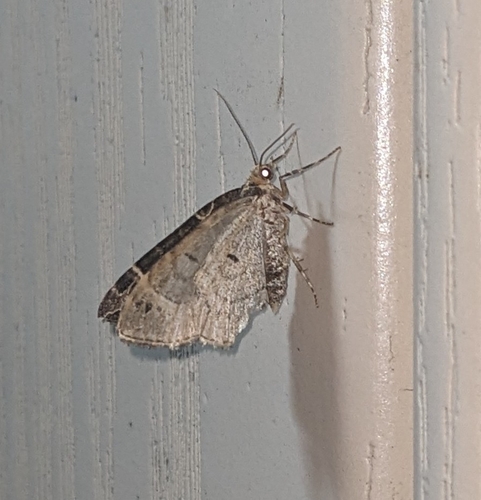
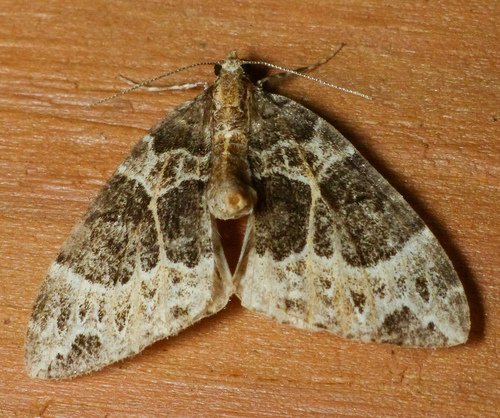
The base of the wings is dark grey with a light band that has many dark spots. The large central area of the wing is black-brown and often shows an almost elliptical white marking in the middle.
Source: Wikipedia
Size
Wingspan ranges from 23 to 27 mm. Forewing length is between 13 and 17 mm.
Source: Wikipedia
Where it lives
Found in semi-shady areas of deciduous and mixed forests, young forest plantations and heaths.
Source: Wikipedia
What it eats
Caterpillars feed mainly on willowherb plants.
Source: Wikipedia
Life cycle
Adults are on the wing in two generations, May-July and August-September. The compact brown-green pupa overwinters.
Source: Wikipedia
When you see it
Flight periods are May to July and August to September.
Source: Wikipedia
Where it comes from
Its range covers most of Europe, the British Isles, extends east through Russia to the Altai, reaches the Arctic Circle, and goes south to the Caucasus. It is also present in North America.
Source: Wikipedia
Lookalikes
Ecliptopera capitata has brighter colours, fewer arrow spots after the discal area, and a yellow-orange head, thorax and abdomen. Lampropteryx suffumata shows more indistinct bowed spots beyond the wavy line, jagged transverse lines and a browner ground colour.
Source: Wikipedia
Where it is found in the US
Recorded in 19 of 51 states and DC. Most records: Vermont, New York, Alaska, Massachusetts, Maine, Washington, Oregon, Wyoming.
Darker = more records. Counts are museum and citizen-science records, not population size.
Source: GBIF
Status: native in North America; native in Canada; native in United States. Source: iNaturalist
Months it is reported in the US
Source: GBIF
More photos
Questions people ask
Are they a pest for gardens or crops?
Their larvae feed on willowherbs, not on garden vegetables or crops.
Source: Wikipedia
Same family (Geometridae)
 Willow BeautyPeribatodes rhomboidaria
 Pale BeautyCampaea perlataDamages trees, gardens or crops
 Large Lace-border MothScopula limboundataDamages trees, gardens or crops
 Riband WaveIdaea aversata
 Yellow Shell MothCamptogramma bilineata
 Large Maple Spanworm MothProchoerodes lineolaDamages trees, gardens or crops
Sources
- Wikipedia: https://en.wikipedia.org/wiki/Ecliptopera_silaceata
Look it up elsewhere: GBIF · iNaturalist · BugGuide · ITIS · Wikipedia
Text written 2026-10-22 from the sources above and checked sentence by sentence against them. Data fetched 2026-10-22.