 Bug FAQ
Small Grey
Eudonia mercurella · Order: Lepidoptera · Family: Crambidae
Also called: Garden Grey
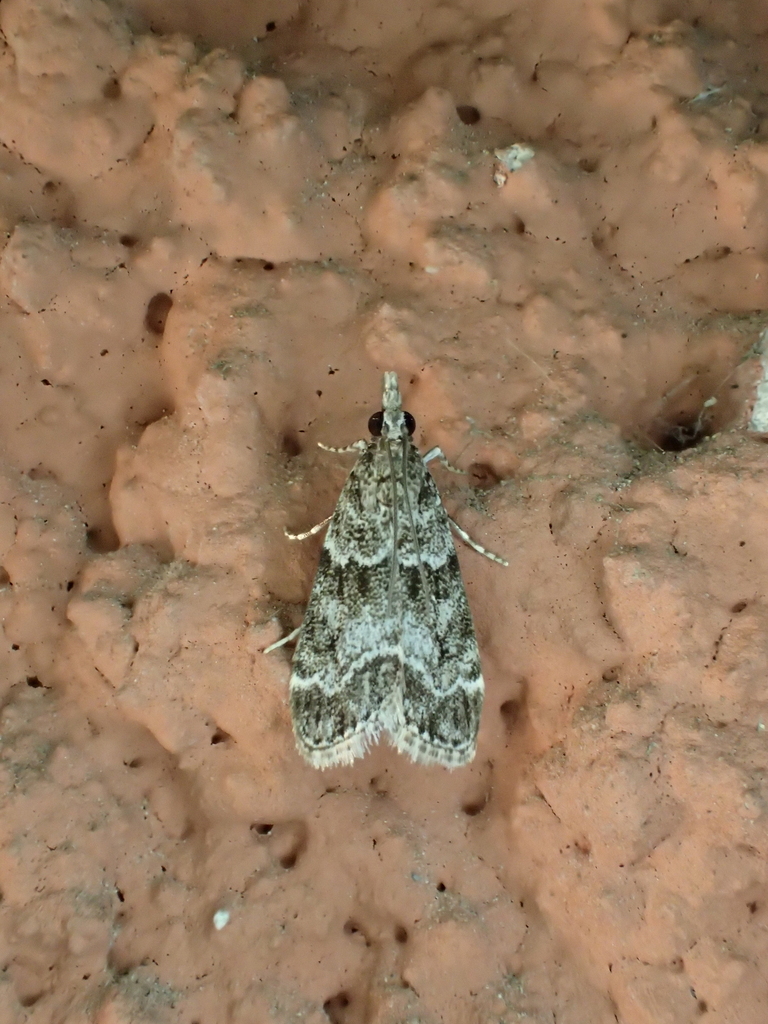
The Small Grey moth has a wingspan of about 16 to 19 mm and its forewings are dark with mixed brown, a darker band near the edge of a pale antemedian line, and a distinct pale post-median line.
Source: Wikipedia
Size
Wingspan ranges from 16 to 19 mm (0.63 to 0.75 in).
Source: Wikipedia
What it eats
Larvae feed on a variety of mosses.
Source: Wikipedia
Life cycle
Adults are on the wing from June to August, depending on location.
Source: Wikipedia
When you see it
Flight period is June through August, varying with geography.
Source: Wikipedia
Lookalikes
It can be confused with Eudonia lacustrata, which has a broken wavy line forming a broad white spot at the wing tip, as well as with Eudonia speideli and pale forms of Eudonia liebmani.
Source: Wikipedia
Questions people ask
Are they a garden pest?
Their larvae feed on mosses, not on garden crops or ornamental plants.
Source: Wikipedia
How can I tell this moth apart from similar species?
Look for the dark forewings with a distinct pale postmedian line and the absence of the broad white spot at the wing tip that characterises Eudonia lacustrata.
Source: Wikipedia
Same family (Crambidae)
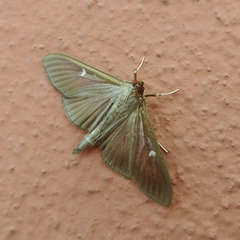 Box Tree MothCydalima perspectalisDamages trees, gardens or crops
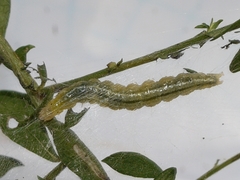 Celery Leaftier MothUdea rubigalisDamages trees, gardens or crops
 Elegant Grass-veneerMicrocrambus elegans
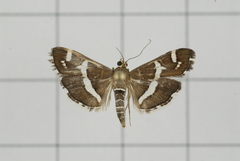 Hawaiian Beet Webworm MothSpoladea recurvalisDamages trees, gardens or crops
 Garden Grass-veneerChrysoteuchia culmellaDamages trees, gardens or crops
 Bluegrass Webworm MothParapediasia teterrellusDamages trees, gardens or crops
Sources
- Wikipedia: https://en.wikipedia.org/wiki/Eudonia_mercurella
Look it up elsewhere: GBIF · iNaturalist · BugGuide · Wikipedia
Text written 2026-10-22 from the sources above and checked sentence by sentence against them. Data fetched 2026-10-22.